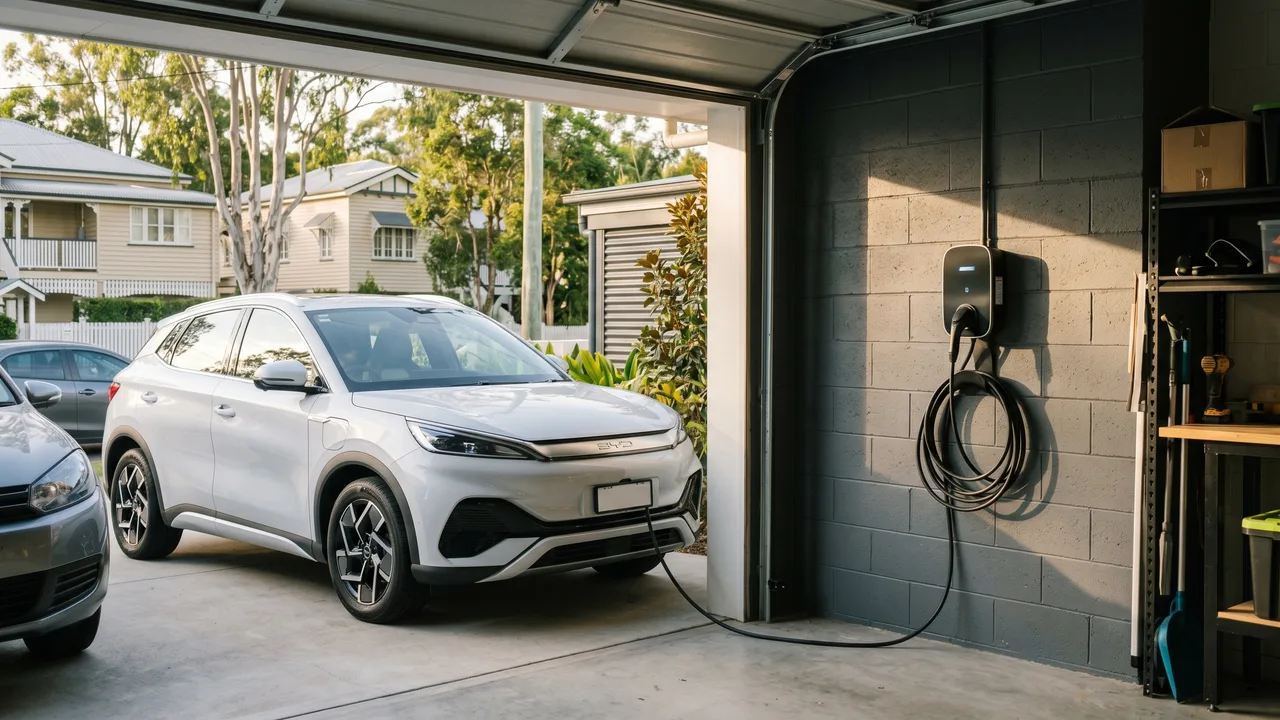
EV Charger Installation
Three-Phase EV Charger Installation.
What Three-Phase EV Charging Actually Means at Home
Most Brisbane homes run on single-phase power, which tops out at around 7 kW for a home EV charger. Three-phase power delivers up to 22 kW, so charging times can drop dramatically. A car that takes 10 hours on single-phase might be full in under 3 hours on a 22 kW three-phase setup, depending on the vehicle's onboard charger limit.
Not every car can accept 22 kW AC charging. Many EVs cap out at 7 kW or 11 kW regardless of what the wall unit delivers. Worth checking your vehicle's spec sheet before committing to the higher-end hardware.
What the Installation Actually Involves
A three-phase charger installation is more involved than a standard single-phase job. Here is what the work typically covers:
- Confirming three-phase supply at your switchboard. Not every Carseldine property has it, so we check before anything else.
- Installing or verifying a dedicated circuit from your switchboard to the charge point, using appropriate cable sizing for 22 kW loads.
- Mounting the charge unit on a garage wall, carport post, or external surface, with weatherproof housing where needed.
- Configuring load management settings if your home already draws high current (ducted air conditioning, pool equipment, induction cooktops).
- Labelling circuits, testing, and issuing a Certificate of Compliance for the electrical work.
We use wall-mounted AC chargers with Type 2 sockets, which suit most EVs and PHEVs sold in Australia. Tethered cables (built-in lead) are available on some models if you prefer convenience over flexibility.
When You Actually Need Three-Phase
A three-phase charger makes sense in specific situations. You probably need one if:
- Your vehicle supports 11 kW or 22 kW onboard AC charging and you want to use that capability at home.
- You regularly arrive home with a near-empty battery and need it full before the next morning.
- You charge during the day and want to maximise the window where your rooftop solar is generating.
- You run a household with two EVs sharing one charger, and single-phase speeds create a bottleneck.
If your car only accepts 7 kW AC (which covers a large slice of the current EV market), a standard single-phase installation will likely suit you just as well and cost less. We will tell you honestly which option fits your setup.
Typical Costs in Brisbane
Three-phase EV charger installation in Brisbane typically sits between $1,800 and $4,500 for a residential job. The spread is wide because several factors move the price:
- Whether your property already has three-phase supply. If it does not, you will need to arrange an upgrade through Energex, which adds time and a separate cost outside our scope of work.
- Cable run length. A switchboard in the garage next to the charge point is simple. A switchboard on the opposite side of the house, or in a second storey, adds labour and materials.
- Switchboard condition. Older switchboards (ceramic fuses, no safety switches) may need an upgrade before a three-phase circuit can be safely added. We cover that as a separate service.
- Charger hardware. A basic 11 kW unit costs less than a smart 22 kW charger with app control, load balancing, and solar integration features.
- Trenching or conduit work. If the cable needs to run underground across a concrete driveway or through a slab, that adds to the job.
What Our Quote Includes (and What It Does Not)
Our quotes typically include labour, cable and conduit, the circuit breaker and isolator, installation of the charger unit itself, and the Certificate of Compliance.
Costs that are usually separate:
- The charger hardware, if you are supplying your own unit.
- Any switchboard upgrade work identified during the site assessment.
- Energex application fees if you need three-phase supply connected to the property.
- Concrete cutting or landscaping reinstatement after trenching.
We go through all of this before you commit, so there are no surprises on the day.
Is Three-Phase Right for Your Property?
A quick way to check: look at your switchboard. Three-phase properties typically have three rows of circuit breakers or a main switch labelled 3-phase, 415 V, or 3P. If you see only one row, you are most likely single-phase. If you are unsure, we can confirm during a site visit.
Carseldine and surrounding suburbs including Albany Creek, Bald Hills, and Bracken Ridge have a mix of three-phase and single-phase properties, with three-phase more common on larger blocks and newer estates.
A Note on Qualifications and Safety
EV charger installation is electrical work. In Queensland, it must be carried out by a licensed electrical contractor and a licensed electrician. The completed work requires a Certificate of Compliance for Electrical Work (CCEW), which is your legal record that the installation meets the wiring rules.
We are licensed and insured to carry out this work in Queensland. Always ask any installer for their electrical contractor licence number and confirm they will issue a CCEW on completion. It matters for your home insurance as much as it does for safety.
If you want to know whether your Carseldine property already has three-phase supply and whether your EV can actually use it, get in touch. A short conversation or a site look can save you from paying for capacity you will never use, or from undershooting and being frustrated with charge times.
Quick answers
Frequently asked.
Does my Carseldine home already have three-phase power?
What is the difference between 11 kW and 22 kW three-phase charging?
How long does a three-phase EV charger installation take?
Can I integrate a three-phase charger with my existing solar system?
What if my property does not have three-phase supply yet?
Do I need a switchboard upgrade before installing a three-phase charger?
Ready to book
Quickest is by phone.
Up-front pricing on the call. Booked in one go. No site visit needed.