EV Charger Installation guide
Does your switchboard need an upgrade before you can install an EV charger?
Does Your Switchboard Need an Upgrade Before You Can Install an EV Charger?
Often, yes. Many Brisbane homes built before the mid-2000s have switchboards that simply weren't designed to carry a dedicated EV charging circuit on top of everything else already running. That said, plenty of newer homes are fine as-is. The honest answer is: it depends on what's already in your switchboard, and you won't know for certain until a licensed electrician has a look.
Here's what's actually going on inside your switchboard, why it matters for EV charging, and what an upgrade typically costs and involves.
What a Home EV Charger Actually Demands from Your Electrical System
A standard Level 2 wall-mounted charger runs on a dedicated 32-amp circuit at 240 volts. That's around 7.2 kilowatts of continuous draw, typically for several hours at a stretch. Unlike running a kettle for three minutes, an EV charger can sit at near-maximum load for four to eight hours overnight.
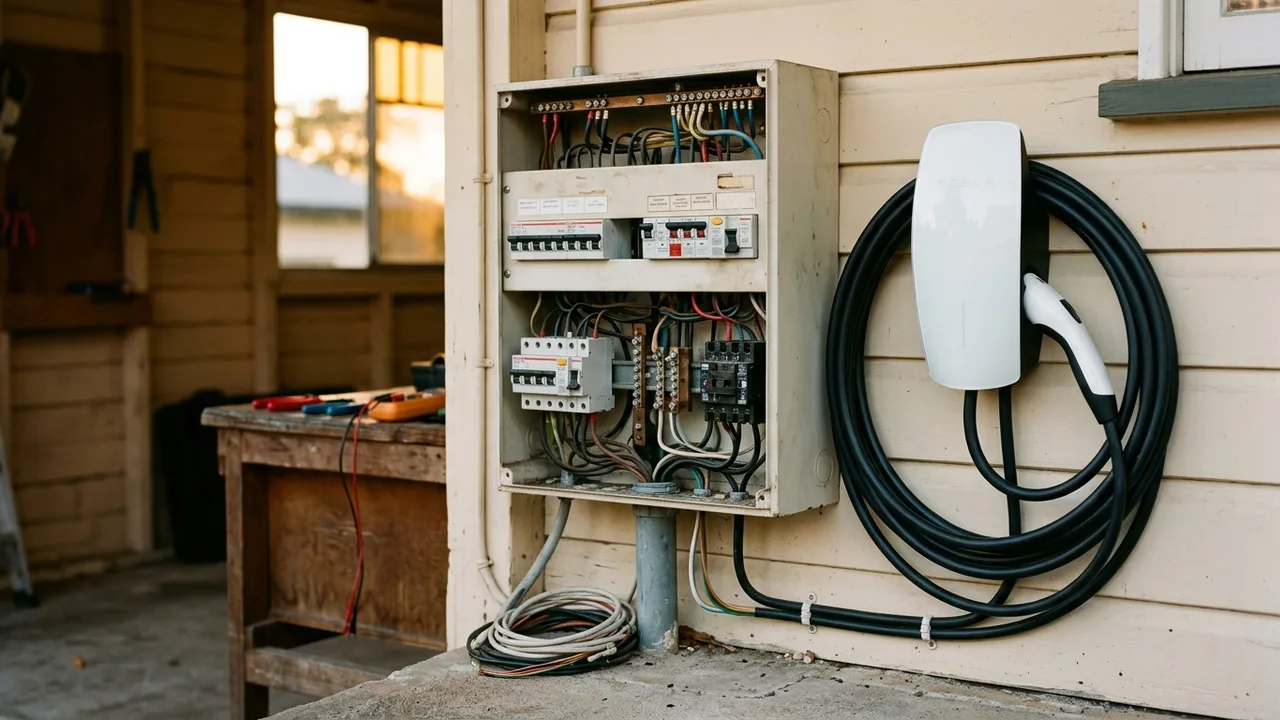
Your switchboard needs to handle that sustained load alongside your air conditioning, hot water system, oven, and anything else you leave running. If the board is already near capacity, adding another large circuit isn't just impractical, it's potentially unsafe.
A three-phase charger pushes that further. Three-phase installations (which deliver 11 kW or more) need a three-phase supply at the property in the first place, and a switchboard set up to match. Homes in Carseldine, Albany Creek, and Bald Hills with older single-phase supplies will need more assessment before going down that path.
What Makes an Older Switchboard a Problem
There are a few specific things electricians look for:
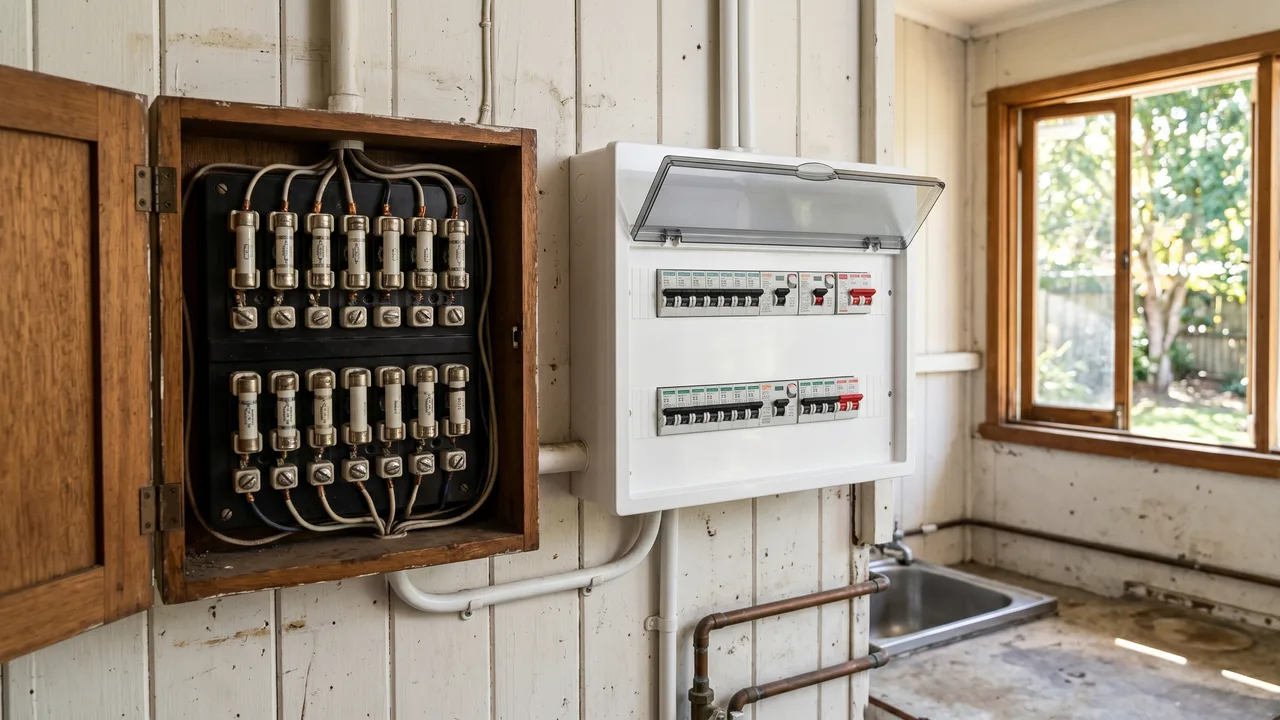
Ceramic fuses instead of circuit breakers. Homes built before roughly the 1980s often still have ceramic fuse wire boards. These aren't compatible with the safety devices required for a modern EV charger circuit, and they can't be simply adapted. A full switchboard replacement is usually needed.
No residual current devices (RCDs). Current Australian standards (AS/NZS 3000) require RCD protection on power and lighting circuits. If your board doesn't have them, any new circuit must include one, and an electrician is likely to recommend upgrading the whole board rather than patching around an outdated setup.
No spare circuit breaker slots. An EV charger needs its own dedicated breaker. If your board is full, the only path forward is upgrading to a larger panel with available space.
Undersized main switch or service fuse. Some older homes in suburbs like Sandgate, Brighton, and Banyo, particularly pre-war and post-war Queenslanders that have been added to over the decades, have a 60-amp or 80-amp main fuse at the street. Adding a 32-amp EV circuit on top of an already loaded service can push the total demand close to that limit. Your electrician will check if Energex needs to be involved.
What a Switchboard Upgrade Actually Involves
A typical switchboard upgrade for EV charging in Brisbane includes replacing the existing panel with a modern consumer mains unit, installing RCDs across all circuits, labelling everything correctly, and adding the dedicated breaker for your new EV circuit. The whole job is done by a licensed electrician and needs to pass inspection.
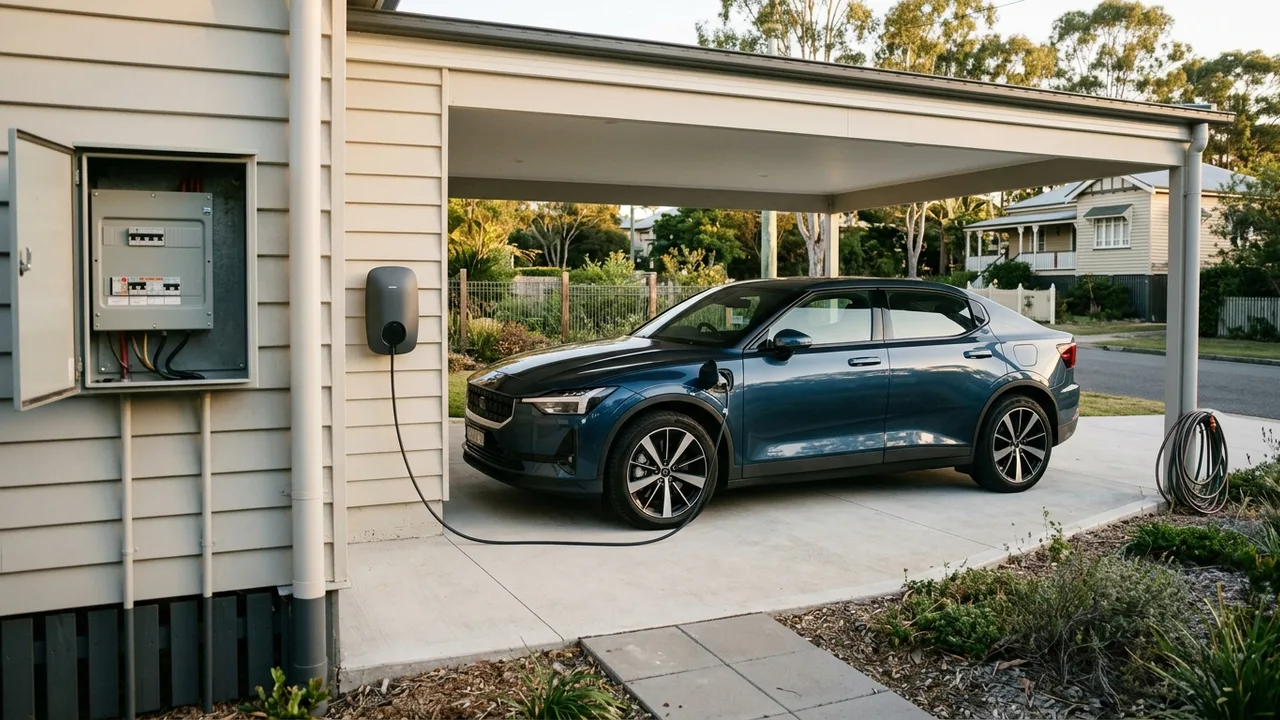
In most cases the work takes half a day to a full day. You'll have a planned power outage for a few hours while the board is swapped out.
If your meter box is old or the wiring between the meter and switchboard is undersized, that scope can expand. Energex sometimes needs to disconnect and reconnect the supply, which adds lead time, occasionally up to a week for scheduling. This is worth factoring in if you're planning around a new car delivery date.
Cost-wise, a switchboard upgrade combined with EV charger installation typically runs somewhere in the $2,500 to $4,500 range for most Brisbane homes, depending on the complexity of the existing setup and whether three-phase conversion is involved. A straightforward EV charger installation on a modern, compliant switchboard with a spare slot can come in closer to the $1,800 to $2,500 range.
Solar Integration: One More Reason to Get the Switchboard Right
If you have rooftop solar, or you're planning to add it, the switchboard becomes even more important to get right the first time. Integrating a solar system with an EV charger, so your car charges off excess solar generation during the day rather than drawing from the grid at peak rates, requires a bit more coordination in the board.
Some smart EV chargers can be set up to communicate with your solar inverter and throttle the charge rate based on available solar output. Getting the wiring and circuit configuration right at the switchboard stage means you're not paying an electrician to come back later and rework things.
Homes across the northern Brisbane suburbs, including Ferny Grove and Bracken Ridge, tend to have decent roof orientation for solar, and we're seeing more customers in those areas wanting the solar-EV integration set up from the start rather than retrofitted.
The DIY Question (and Why the Answer Is No)
It's worth addressing this directly. EV charger installation in Australia is not a DIY job. Under Queensland's Electrical Safety Act, electrical work beyond defined minor tasks must be carried out by a licensed electrical contractor. This includes installing the charger, running the circuit cable, and any switchboard work.
Beyond the legal side, a faulty EV charger installation is a genuine fire risk. The sustained high loads involved mean that poor connections, undersized cable, or missing protection devices can cause problems that a quick visual check won't reveal for months.
Some homeowners ask about buying the charger unit themselves to save money. That's generally fine. Most reputable wall-mounted charger brands (Zappi, Wallbox, Tesla Wall Connector, Fronius Wattpilot, and others) are sold through retailers, and a licensed electrician can supply and install them, or install a unit you've already purchased. Just confirm compatibility before you buy.
What to Do Before You Call an Electrician
You can do a bit of groundwork yourself before booking an assessment. Take a photo of your switchboard and note whether you see ceramic fuses or modern circuit breakers. Count the spare slots, if any. Check whether the main switch is labelled with an amperage. Note where your meter box is relative to your garage, since longer cable runs affect cost.
If you have solar, have your inverter model name ready. If you're in a townhouse in Boondall or an apartment complex with a shared carpark, the situation is different again. Strata and apartment installations involve the body corporate and sometimes require a separate metering arrangement, so it's worth flagging that upfront.
A Straightforward Way to Think About It
If your home was built after about 2005 and has had any electrical work done since, there's a reasonable chance your switchboard is already in good shape and the EV charger installation is relatively straightforward. If your home is older, or you've never had the switchboard assessed, budget mentally for the possibility of an upgrade and treat it as good value regardless. A modern switchboard is safer, better protected, and ready for whatever else you want to add down the track, whether that's battery storage, a second EV, or just a hot tub.
When you're ready to find out exactly what your home needs, we offer a paid site assessment that covers off both the switchboard and charger installation scope together. It takes about an hour, gives you a clear written quote with no pressure, and the assessment fee comes off the job cost if you proceed. We cover Carseldine, Bald Hills, Albany Creek, Ferny Grove, Bracken Ridge, Sandgate, Brighton, Boondall, and Banyo.
Quick answers