EV Charger Installation guide
Does charging your EV from solar panels actually save money in Brisbane?
Yes, Solar Charging an EV in Brisbane Generally Does Save Money
The short answer is yes, charging your electric vehicle from rooftop solar typically saves money in Brisbane compared to drawing from the grid, sometimes significantly. But the actual saving depends on how much solar you have, when you charge, and what your current electricity tariff looks like. The details matter, and they are worth understanding before you spend anything.
What the Numbers Actually Look Like
Brisbane sits in a strong solar zone. Most homes in the northern suburbs, from Carseldine and Bald Hills through to Albany Creek and Ferny Grove, receive somewhere between 4.5 and 5.5 peak sun hours per day on average. That is genuinely useful if you are trying to match solar generation to EV charging.
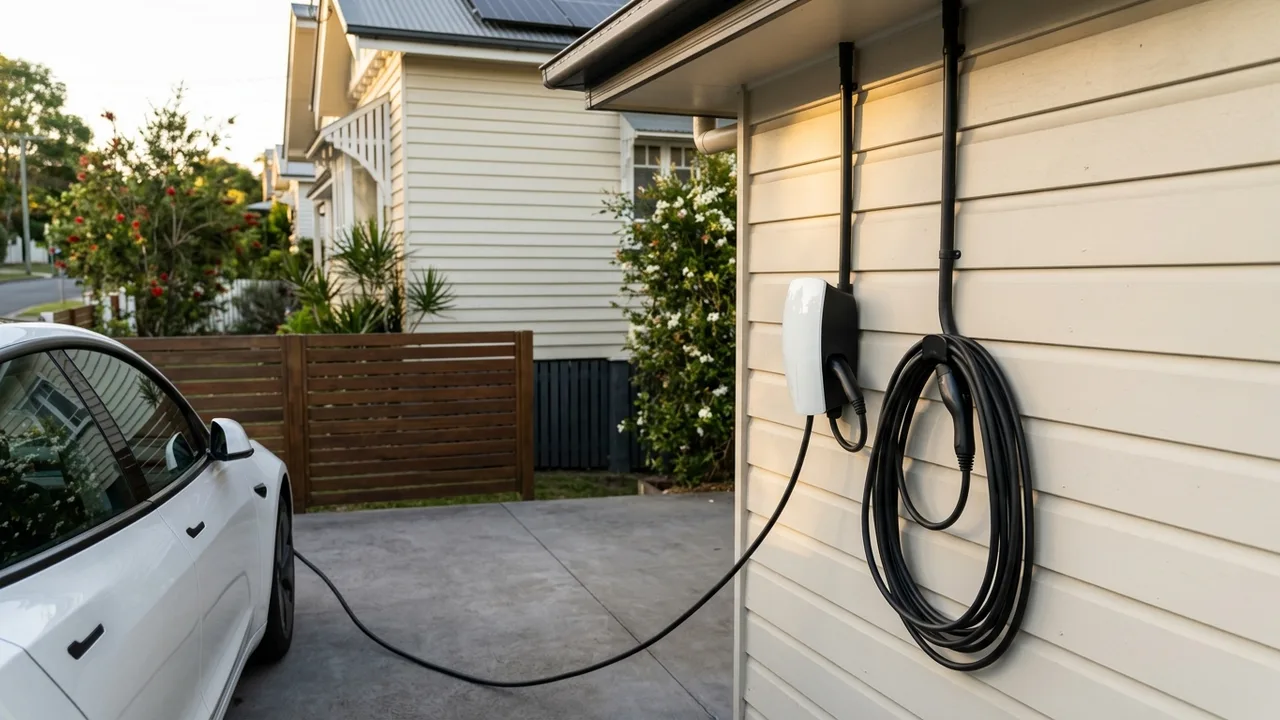
To put it in concrete terms: a typical mid-size EV (say, a BYD Atto 3 or a Tesla Model Y) uses roughly 15-20 kWh per 100 km of driving. The average Brisbane household drives somewhere around 40-50 km a day, so daily charging needs land around 6-10 kWh in most cases.
A modest 6.6 kW rooftop system in this region typically produces 25-30 kWh on a good sunny day and closer to 10-15 kWh on an overcast one. So on a clear Brisbane day, there is a reasonable chance your solar array is generating more than enough to cover the car. The question is whether that surplus is actually going into your battery on wheels rather than back to the grid.
Grid electricity in south-east Queensland currently sits around 28-34 cents per kWh for most residential customers (check your bill, as tariffs vary by retailer). Solar feed-in tariffs, on the other hand, have dropped considerably and typically sit between 5 and 10 cents per kWh with most retailers. That gap, roughly 20-25 cents per kWh, is what you capture every time you charge from self-generated solar rather than exporting it and buying grid power later. Over 15,000 km of annual driving, that difference can add up to $400-$700 per year, sometimes more if you are on a higher tariff or driving a heavier vehicle.
The Timing Problem (and How to Solve It)
Here is the catch that most solar-EV articles skip over: solar generation peaks between roughly 10 am and 2 pm. Most people plug in their car when they get home at 6 or 7 pm, which is exactly when the sun has gone and grid demand is highest.
If you are on a time-of-use tariff, evening charging can cost you 35-45 cents per kWh or more during peak periods. You are paying the most expensive rate possible, and your solar export from earlier in the day earned you almost nothing by comparison.
The practical fix is scheduled or solar-matched charging. Most Level 2 home chargers (the wall-mounted units, also called EVSE, or Electric Vehicle Supply Equipment) have scheduling functions built in. You set a window, say 10 am to 2 pm, and the car charges during that period while you are at work and the sun is overhead. Some chargers go further with solar-divert or solar-matched modes, where the charger reads your inverter's output and adjusts charging speed to match available surplus power in real time.
This is the core of what we do when we integrate a solar system with an EV charger. Getting that communication working correctly between your inverter brand and your charger brand takes some care. Not all combinations talk to each other cleanly out of the box.
Does Your Existing System Have Enough Capacity?
A 5 kW or 6.6 kW system already on your roof may be enough to handle EV charging during the day, particularly if you are not home and your household baseline load (fridge, router, standby devices) is low. In that scenario, a large chunk of midday generation is effectively going spare, and the car becomes a very useful load to absorb it.
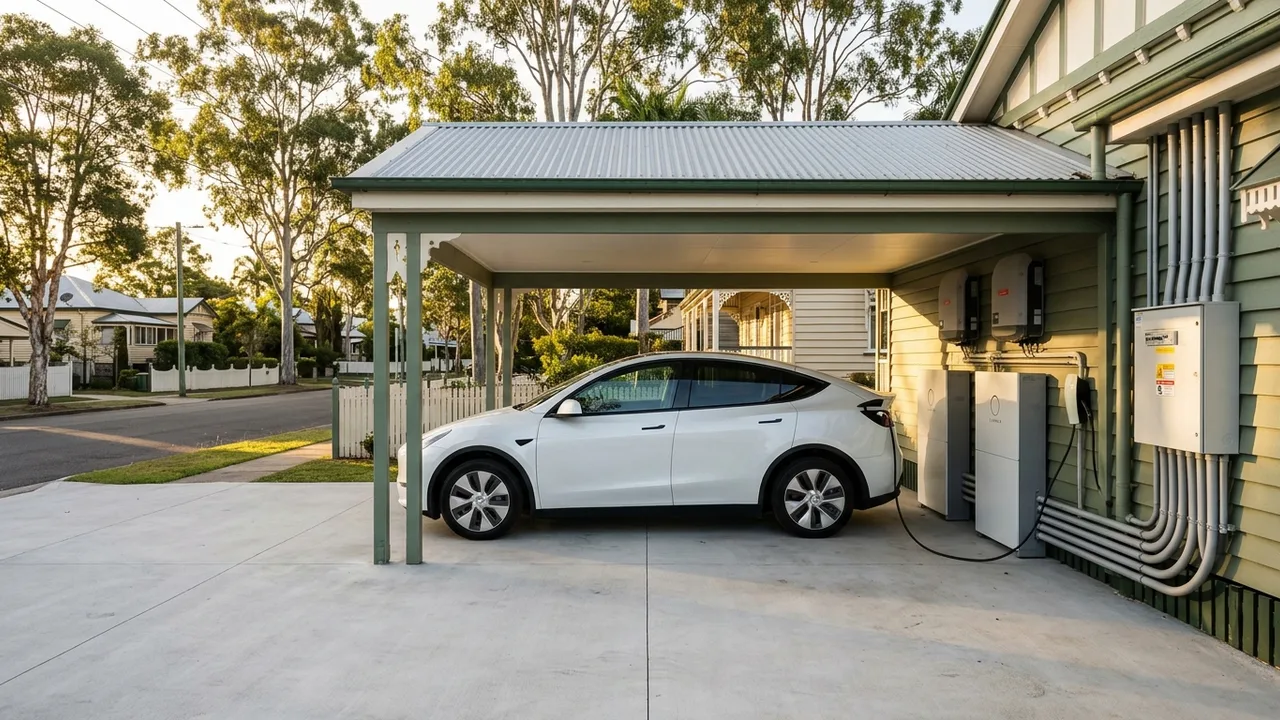
If your system is older or undersized (3 kW or smaller, which is common in homes that installed solar in the early 2010s), there may not be enough headroom to both meet household demand and meaningfully charge a vehicle in the same window. Expanding the system is one option; just charging overnight on a cheap off-peak tariff (if your retailer offers one) can be a more practical and cheaper approach in the short term.
For homes in Sandgate, Brighton, and Bracken Ridge near the bay, salt air corrosion on older panels and wiring is worth factoring into any expansion plans. An ageing system that has degraded may produce less than its nameplate rating suggests.
What a Proper Solar-Integrated Charger Setup Costs
A basic Level 2 home charger supply and installation in Brisbane typically runs $1,800 to $2,500 for a straightforward single-phase job where your switchboard is already adequate and the cable run is short. Add solar integration (the software configuration and any additional wiring to connect charger to inverter) and you are often looking at $2,200 to $3,500 depending on complexity.
If your switchboard needs upgrading to handle the dedicated circuit safely, that adds cost and is often a required step regardless of solar. An older switchboard with ceramic fuses or undersized mains cable is not safe for a continuous 32-amp EV charger load and will need attention before anything else goes in.
Three-phase charger installations are available for homes with three-phase supply (more common in newer builds and some older Queenslanders that were upgraded for air conditioning). These run faster, typically 7 to 22 kW charging rates, but cost more upfront, usually $3,000 to $4,500 installed. For most people doing an overnight or midday top-up, single-phase is sufficient.
Payback periods are genuinely variable. A household driving 15,000 km per year, capturing 70% of charging from solar, and previously paying grid rates could recover the charger installation cost in 3-6 years on energy savings alone. That does not account for reduced fuel costs (petrol versus electricity), which make the case considerably stronger.
Honest Trade-offs to Consider
Solar charging is not automatically the right move for every situation. Here are the real trade-offs:
- Home all day vs. commuter household. If someone is home during the day, midday solar charging works well. If the house is empty from 7 am to 6 pm and you have no scheduled charging, you may still default to evening grid charging by habit.
- Tariff structure matters a lot. A flat-rate tariff with a decent feed-in rate is a different equation than a time-of-use tariff. Run your own numbers using your actual bill before assuming a particular saving.
- Battery storage adds cost. Some people assume you need a home battery to make solar EV charging work. You do not. Charging directly from solar during generation hours is simpler and cheaper. A home battery helps but adds $8,000-$15,000 to the equation and changes the payback calculation considerably.
- Vehicle compatibility. Most modern EVs accept scheduled charging via their own app or the charger's app. A small number of older or cheaper EVs have limited scheduling options. Check your vehicle's documentation before selecting a charger.
A Sensible Starting Point
If you already have solar and are buying or have just bought an EV, installing a properly integrated Level 2 charger is one of the more straightforward ways to put that solar generation to use rather than selling it cheaply back to the grid. The economics are genuinely favourable in Brisbane given our sun hours and current tariff structure.
If you are starting from scratch with no solar and no charger, the charger alone still makes sense (slow overnight charging from a standard powerpoint risks overheating older wiring and should not be the long-term plan). Solar adds a meaningful extra layer of saving, but it is a separate investment with its own payback period.
The honest recommendation: get a clear picture of your current solar production, your tariff type, and your daily driving distance before committing to a specific setup. That conversation does not need to be complicated. If you are in Carseldine, Albany Creek, Ferny Grove, or any of the surrounding suburbs and want a straightforward assessment of what would actually work for your home, we are happy to talk it through with no pressure to proceed.
Quick answers