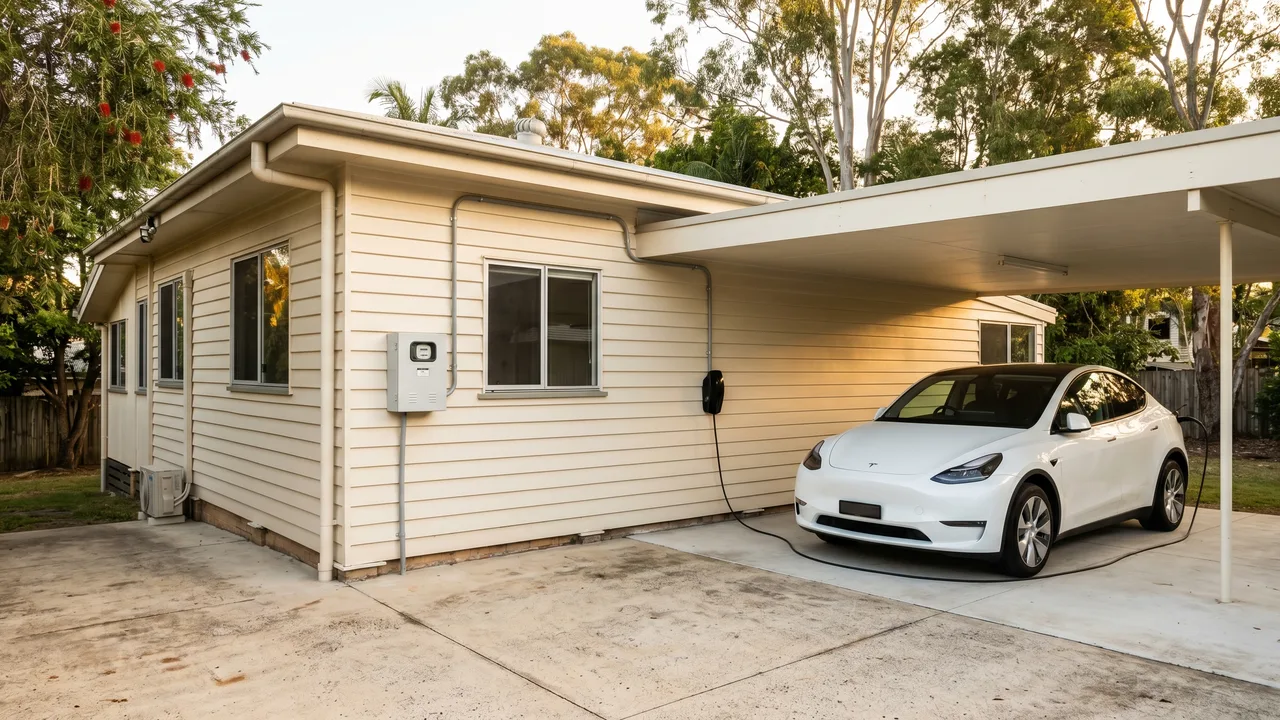
EV Charger Installation guide
Why older homes in Albany Creek and Ferny Grove need extra electrical work before EV charging
Older homes in Albany Creek and Ferny Grove often need extra electrical work before an EV charger can be safely installed. The short answer is that many of these houses were wired decades ago, long before anyone imagined plugging a car in at home, and the existing electrical infrastructure simply was not designed to carry that kind of continuous load.
If you have recently bought an EV or you are about to, understanding what is actually involved - and what it might cost - will save you from nasty surprises once a sparky starts opening up your switchboard.
What "older home" actually means in this context
Albany Creek grew substantially through the 1970s and 1980s. Ferny Grove has a similar story, with a lot of its housing stock dating from the same era, plus some older Queenslander-style homes that predate that period by decades.
For electrical purposes, the critical threshold is roughly pre-1990 construction. Homes built before that point are more likely to have:
- A switchboard with ceramic fuse cartridges rather than modern circuit breakers
- Single-phase power with a 60 amp or 80 amp main fuse (rather than the 100 amp service more common in newer builds)
- Wiring runs in the original TPS (thermoplastic-sheathed) cable that is now 40-plus years old
- No residual current devices (RCDs), which are now required under Australian standards for circuits serving a garage or carport
- A consumer mains cable that runs from the street to the switchboard and may not have the capacity to handle added load
None of these things automatically means your home is unsafe for everyday use. They do mean that adding a dedicated EV charging circuit - which typically draws 7.2 kilowatts continuously for several hours - requires a proper assessment before anything is connected.
Why EV charging is harder on old wiring than most appliances
A 7.2 kW wall charger (the standard Level 2 charger we install on a dedicated 32 amp circuit) draws around 32 amps continuously. That is the key word: continuously. Your oven might spike to a similar draw, but you use it for 45 minutes. An EV charger might run for four to eight hours overnight.
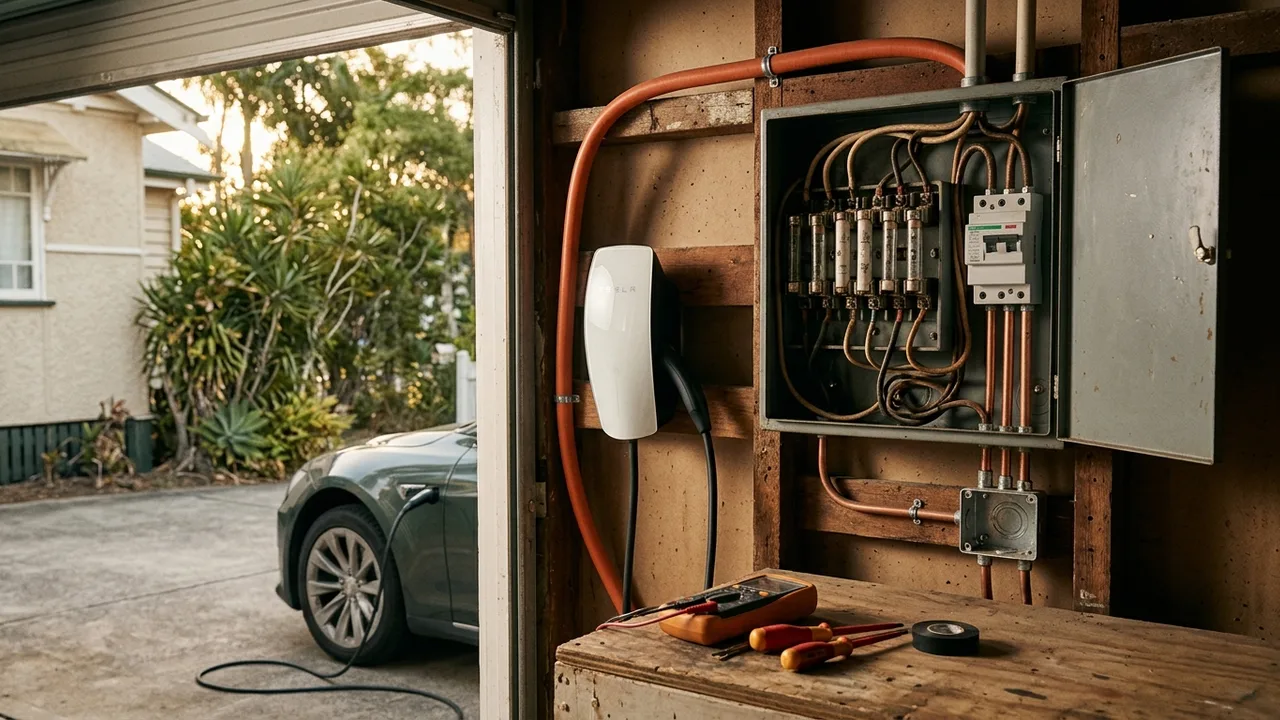
Sustained load like that causes heat to build up in cables, terminals, and fuse carriers. In a well-maintained modern switchboard with appropriately sized wiring, that heat dissipates safely within design limits. In an older switchboard with ceramic fuses and aging cable insulation, the margins are much tighter.
The other factor is the total load picture. If your Albany Creek home already runs a ducted air conditioner, an electric hot water system, and a pool pump, your switchboard may be close to its practical limit before the car charger is even considered. Adding a dedicated circuit without first auditing that load can push things into territory that causes nuisance tripping at best, or overheating at worst.
The switchboard upgrade question
This is typically the biggest cost variable for older homes. A switchboard upgrade in Brisbane generally runs somewhere between $1,200 and $2,500 depending on the complexity, how the mains cable is routed, and whether the meter box needs attention too.
For many Albany Creek and Ferny Grove homes, the upgrade involves replacing ceramic fuse carriers with modern circuit breakers and RCDs, installing a new enclosure if the old one is undersized, and potentially requesting an energy retailer visit to isolate the supply while work is done on the mains side.
Here is the honest trade-off: some homeowners balk at paying for a switchboard upgrade on top of the charger installation, and you can understand why. But a switchboard that is already overdue for an upgrade will eventually need one regardless of the EV. The car charger just brings the timeline forward. In that light, doing both jobs at once is usually cheaper than doing them separately, and you end up with a switchboard that meets current standards for the whole house, not just the charger circuit.
If your switchboard is already a modern unit with spare capacity and RCDs fitted, you may not need an upgrade at all. We assess this during quoting, and we will tell you plainly which category you fall into.
Consumer mains capacity and the supply side of the equation
Beyond the switchboard itself, there is the supply cable that runs from the street (or pole) to your meter and then to the switchboard. In many older Brisbane properties, this cable was sized for the household loads of the 1970s or 1980s.
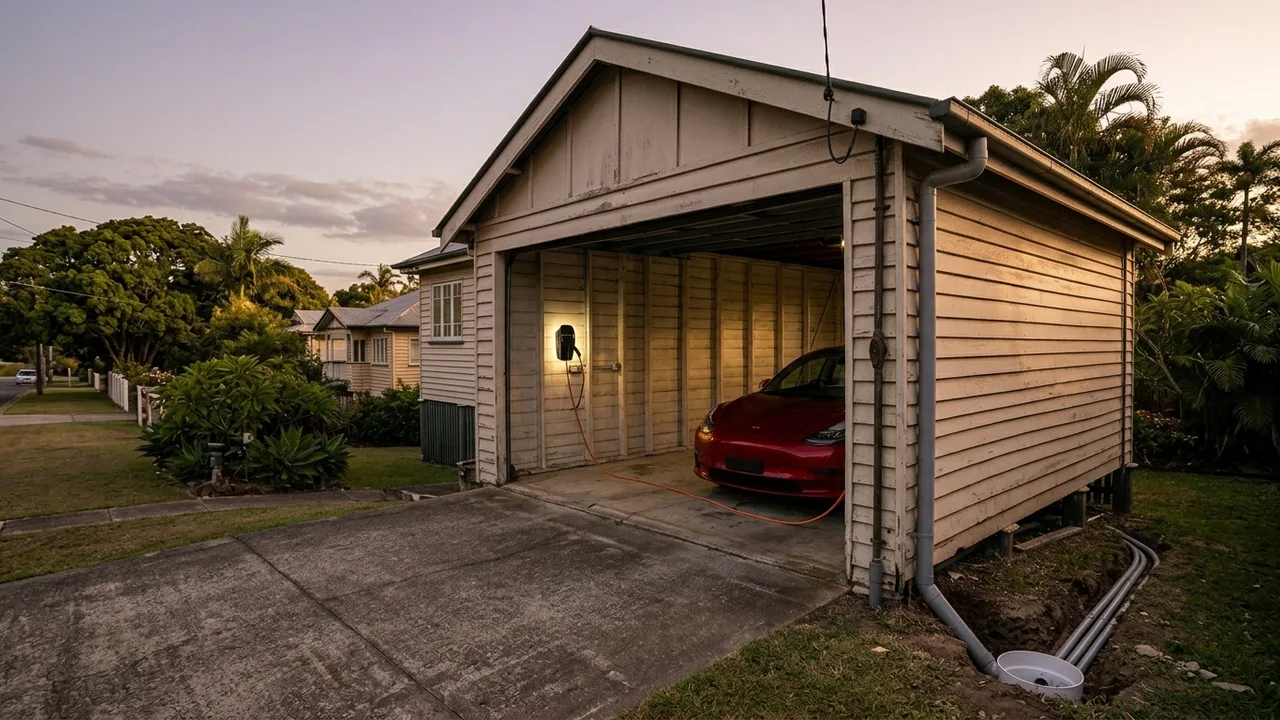
If your existing consumer mains is undersized, adding an EV charger circuit can cause voltage drop issues or require an Energex (the local distribution network) upgrade to the service. An Energex service upgrade is a separate process and can add time - typically a few weeks - and potentially cost to the project.
The good news is that for most standard single-phase homes in Albany Creek and Ferny Grove, the existing service is adequate for a 7.2 kW charger as long as the switchboard itself is in order. Three-phase installation (which offers faster charging speeds, typically 11-22 kW) is a different matter; if your street only has single-phase available, three-phase is not an option without significant network work, and that is worth checking early.
RCDs, earthing, and the compliance picture
Australian Standard AS/NZS 3000 (the "Wiring Rules") and local Queensland electrical safety requirements mean that any new circuit, including an EV charger circuit, must include RCD protection. Older homes without RCDs on their existing circuits are not required to retrofit RCDs to every circuit simply because you are adding a new one, but the new EV circuit itself must have RCD protection.
Earthing is the other compliance area worth knowing about. Some older homes have an earthing arrangement that was compliant when installed but does not meet current standards. A qualified electrician is required to flag this during any new installation work. In practice, it means earthing remediation can sometimes appear as an unexpected line item on quotes for older homes.
We build a visual assessment of the existing switchboard and earthing into our quoting process for Albany Creek and Ferny Grove jobs specifically because of how common these issues are in the local housing stock.
What the upgrade path actually looks like, step by step
To make this concrete, here is a typical sequence for an older Albany Creek home needing preparatory work:
- Site assessment. An electrician visits and inspects the switchboard, estimates the existing load, checks the mains cable, and identifies the best cable run to the garage or carport.
- Switchboard upgrade (if required). Old fuse carriers are replaced with circuit breakers and RCDs. Enclosure is replaced if needed. This is typically done as a morning's work.
- EV charger circuit installation. A dedicated 32 amp circuit is run from the switchboard to the garage, with appropriate conduit or surface-mounted cable management.
- Wall charger installation. The wall-mounted unit is fixed, wired, and tested.
- Certificate of Test. The installing electrician issues a Certificate of Test (Form 4) as required under Queensland's Electrical Safety Act. This document is your record that the work was inspected and compliant.
Total cost for a home that needs a switchboard upgrade plus charger installation typically falls in the $2,800 to $4,200 range. Homes with a modern switchboard and a straightforward cable run are more typically in the $1,800 to $2,400 range.
Making a sensible decision
You do not need to take anyone's word for what your home needs. The right starting point is a proper on-site assessment by a licensed electrician who will look at your actual switchboard, not just ask a few questions over the phone.
If your home is a 1980s brick in Albany Creek or a 1970s weatherboard in Ferny Grove, plan mentally for the possibility of a switchboard upgrade. Budget for it, and treat anything less than that as a pleasant surprise. The preparatory work is not the fun part of getting an EV charger, but it is the part that makes the installation safe and compliant for the 15-plus years you will likely use it.
We cover Albany Creek, Ferny Grove, and the broader northern Brisbane area, and we are straightforward about what a job involves before you commit to anything. If you want to know what your specific setup would require, a site visit is the only honest way to answer that question properly.
Quick answers