EV Charger Installation guide
Is a standard power point good enough to charge your EV at home?
Yes, But With Some Important Caveats
A standard 10-amp power point will charge your EV. It is just painfully slow and, depending on your home's wiring, it carries real safety risks if used night after night. For many drivers, it is fine as a short-term stopgap. For regular home charging, it falls short in ways that matter.
Here is an honest look at how a standard power point compares to a dedicated home charger, what the risks actually are, and how to decide what makes sense for your situation.
What "Mode 1" Charging Actually Means
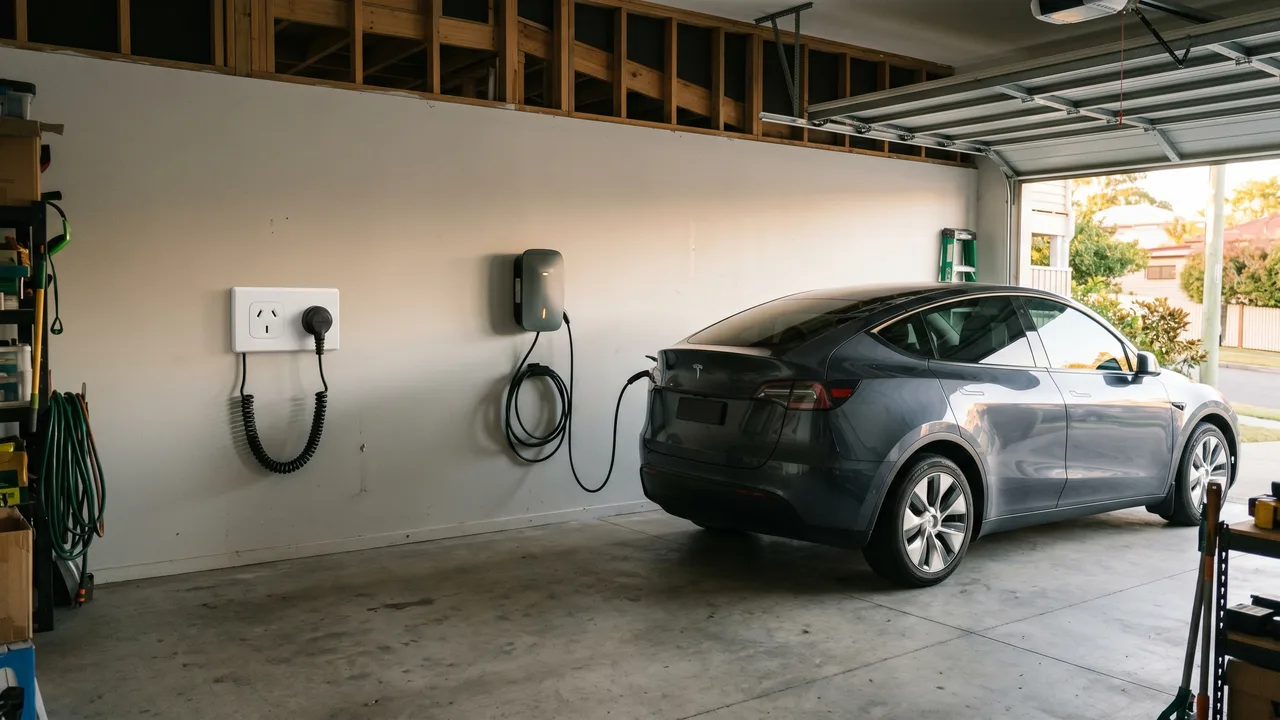
Plugging your EV into a regular household socket is called Mode 1 charging. You are drawing power through an ordinary 10-amp outlet, typically via a cable that came with your car or an aftermarket equivalent.
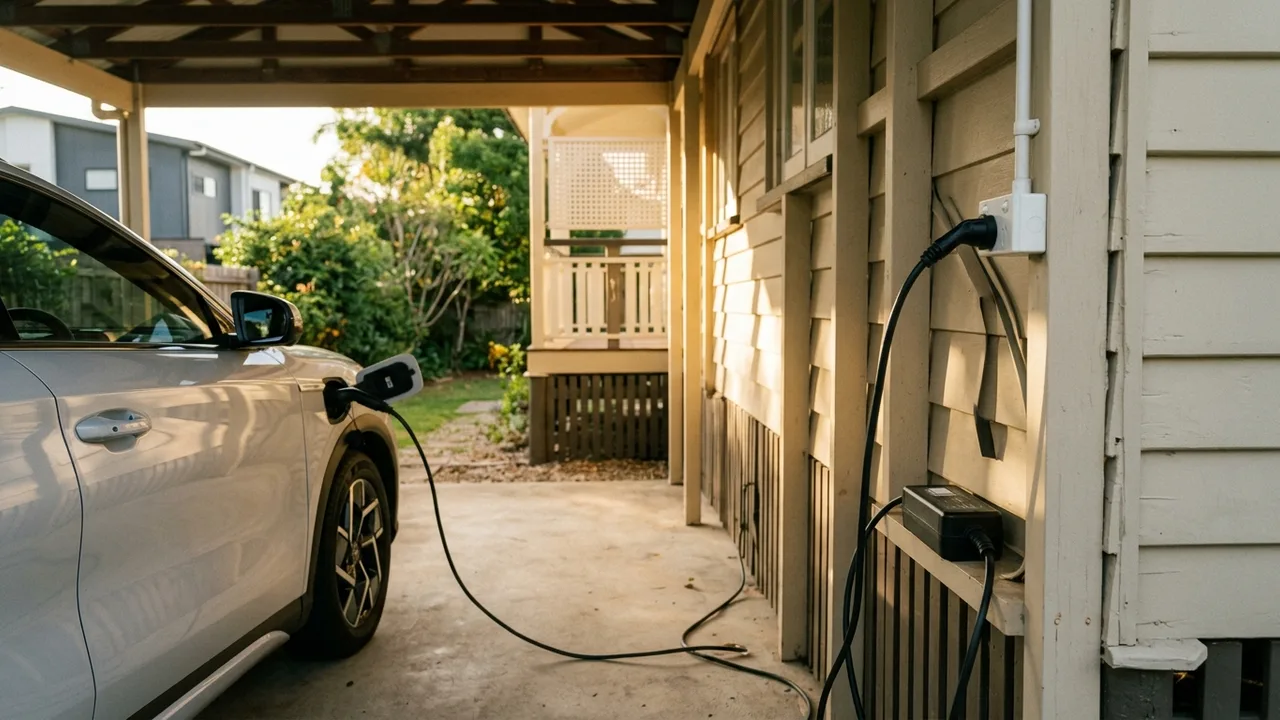
The charging rate you get from a standard point is roughly 2.4 kilowatts (kW). In practice, most modern EVs charge at around 1.8-2.2 kW on a 10-amp circuit once losses are factored in. That translates to somewhere between 10 and 15 kilometres of range per hour of charging.
If you drive 30-40 km a day, as many Brisbane commuters do, you need roughly two to four hours on the plug each night just to recover what you used. That sounds manageable until your car arrives home at 30% charge after a longer day. You do the maths.
A Level 2 wall-mounted charger (Mode 3 charging) running on a dedicated 32-amp circuit delivers 7-22 kW depending on the unit and whether your home has single-phase or three-phase power. That same 30-40 km of range comes back in about 30-45 minutes.
The Real Safety Concern With Standard Points
The slow speed is an inconvenience. The safety side is worth taking more seriously.
Standard power points and their wiring are designed for intermittent use. A kettle, a lamp, a phone charger. They are not rated for eight or ten hours of continuous near-maximum load, which is exactly what overnight EV charging is.
The specific risk is heat. Prolonged high current through a connection that has any age-related wear, corrosion, or loose fitting can cause the socket or the wiring behind it to overheat. Older homes in suburbs like Ferny Grove, Albany Creek, and parts of Bracken Ridge often have switchboards and cabling that are 30-plus years old. Some still have original wiring that has never been properly assessed.
This does not mean every standard point will fail. But the combination of old wiring, an extension cord (which dramatically increases risk), and nightly eight-hour sessions is where problems have occurred. A dedicated circuit with a purpose-built charger removes those variables.
One practical check: if your current switchboard uses older ceramic fuses rather than modern circuit breakers with residual current devices (RCDs), that is a strong signal to get an electrician to assess the board before you start regular EV charging at all.
What a Dedicated Home Charger Actually Costs
A wall-mounted Level 2 charger installed by a licensed electrician in the Brisbane area typically costs between $1,800 and $4,500 all up. That range covers:
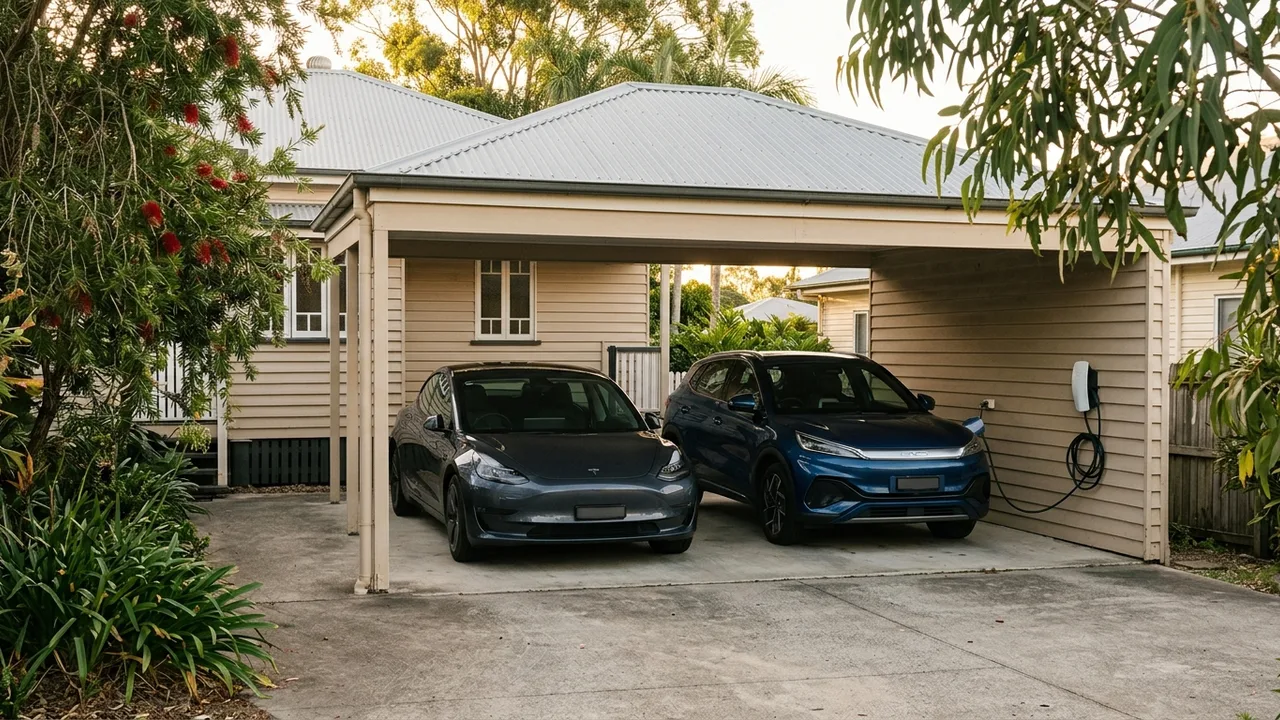
- The charger unit itself (generally $500-$1,500 depending on brand, smart features, and output)
- The dedicated circuit run from your switchboard to the install point
- Any switchboard upgrade work if your current board cannot safely handle the additional load
- Compliance certification to Australian Standard AS/NZS 3000
The lower end of that range suits a straightforward single-phase installation in a new home with a modern switchboard and a short cable run. The upper end applies to older homes needing switchboard work, longer conduit runs, or three-phase installations for faster charging.
If your switchboard is already full or does not have RCD protection on all circuits, budget for an upgrade. That adds cost but it is work that was overdue anyway, not just an EV tax.
Brisbane-Specific Factors to Consider
A few things make the Brisbane context slightly different from what you might read in generic guides written for Melbourne or Sydney.
Heat and charger placement. Brisbane summers are hard on electrical components. A charger installed in a north-facing carport with no shade will run hotter than one inside a garage. Most modern units are rated for the temperatures we see here, but it is worth confirming the operating range spec before buying. Some bayside homes in Sandgate and Brighton also deal with salt air, which accelerates corrosion on exposed fittings over time. Weatherproof enclosures and marine-grade fittings are worth asking about if your installation is outdoors and within a kilometre or two of the water.
Solar integration. A significant number of homes in Carseldine, Bald Hills, and Albany Creek already have rooftop solar. If yours does, a smart charger that communicates with your inverter or uses a current-sensing clamp can direct excess solar generation into your car rather than exporting it to the grid for a few cents per kilowatt-hour. That changes the economics of home charging considerably. It is not something a standard power point can do.
Older Queenslander wiring. If you are in an older character home, particularly in suburbs closer to the Inner West, substandard or aluminium wiring in walls is not unusual. An electrician doing an EV charger installation should identify this, but it is worth flagging upfront so the quote reflects reality.
Should You Upgrade Now or Wait?
There are reasonable cases for sticking with a standard point, at least temporarily.
If you have just bought your first EV, are not sure how much you will drive it, and your current power point is modern, correctly rated, and not on an extension cord, a few months of Mode 1 charging while you get a sense of your actual usage patterns is not unreasonable. Many EV drivers do this.
The calculus shifts once:
- You are regularly arriving home below 40% charge and struggling to recover overnight
- You want to use solar to charge the car
- Your current socket is old, in a garage with suspect wiring, or you have been using an extension lead
- You buy a second EV or expect to
At that point, the $1,800-$4,500 installation cost typically pays back in convenience and reduced running costs within a few years, faster if solar integration means you are charging from generation you would otherwise export cheaply.
Three-phase power, if you already have it or are willing to have it connected, unlocks charger speeds of 11-22 kW. For most households this is not necessary. But if you regularly need a full charge in a hurry, or you are charging a vehicle with a large battery (80-100 kWh), it is worth a conversation with your electrician.
A Straightforward Way to Think About It
A standard power point is not dangerous by definition. It is just a tool being used outside the purpose it was designed for.
If you are driving a typical Brisbane daily distance of under 50 km, your power point is reasonably modern, and you are not in a rush, it will keep you topped up. You are living with a trade-off: slow charging and a small background risk in exchange for not spending money yet.
If any of the risk factors above apply to your home, or if slow charging is already grinding at you after a few weeks, a dedicated Level 2 installation is the sensible next step. It is not a luxury item. It is the actual intended way to charge an EV at home.
We install home EV chargers across Carseldine, Bracken Ridge, Albany Creek, Ferny Grove, Sandgate, Brighton, Boondall, Banyo, and Bald Hills. If you want to talk through what your specific home and usage would need before committing to anything, we are happy to do that without pressure.
Quick answers