EV Charger Installation guide
How do you know if an existing EV charger installation is safe and up to code in Queensland?
How Do You Know If an Existing EV Charger Installation Is Safe and Up to Code in Queensland?
The short answer: you need a licensed electrician to inspect it. Visual checks can flag obvious problems, but the real risks, such as undersized cabling, incorrect earthing, or a missing residual current device (RCD), are hidden inside the wall or switchboard. If you've moved into a home with an EV charger already installed, or bought a second-hand property in Carseldine, Bracken Ridge, Albany Creek, or anywhere else in the Brisbane northside, don't assume the previous owner had the work done correctly.
Here's what a proper compliance check involves, what can go wrong, and how to decide what to do about it.
What Queensland Law Actually Requires
In Queensland, all EV charger installations must comply with AS/NZS 3000:2018 (the Wiring Rules) and the Energy and Water Ombudsman Queensland's licensing framework. The installer must be a licensed electrical contractor, and the work must be inspected and tested before use. For installations completed after 1 January 2023, compliance documentation should have been issued and lodged with Ergon or Energex (the distribution network for south-east Queensland, including Brisbane).
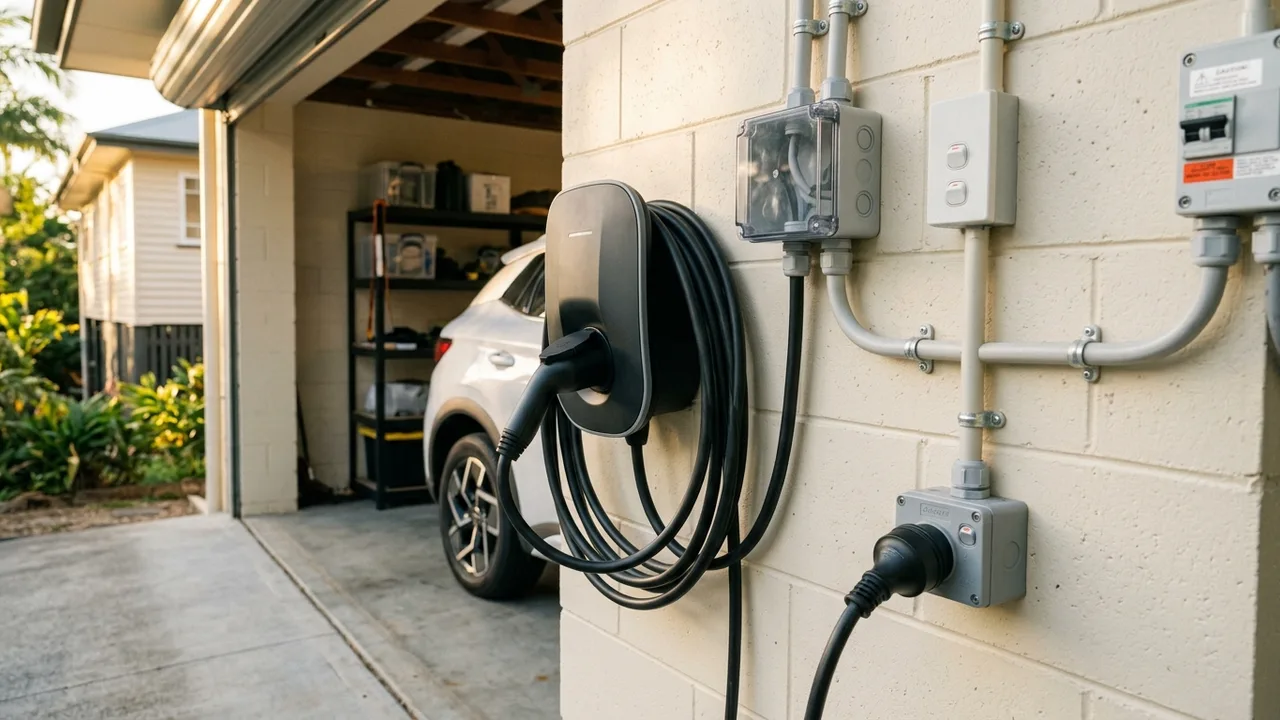
A certificate of compliance (sometimes called a Form 4 in Queensland) should exist for the work. If the previous owner can't produce one, that's your first red flag. It doesn't mean the installation is dangerous, but it does mean there's no independent record that it was tested at the time.
One more point worth knowing: the Australian standard for electric vehicle charging infrastructure, AS/NZS 62196 and the associated AS 3000 guidelines, have been updated as EV charger technology has evolved. An installation done even three or four years ago may have been done to an older interpretation. That doesn't automatically make it non-compliant today, but it's worth having an electrician's eyes on it.
The Five Things Most Likely to Be Wrong
In our experience inspecting charger installations around Brisbane's northside suburbs, these are the problems that come up most often.
1. No dedicated circuit. A Level 2 wall charger (typically 7kW or 11kW) needs its own circuit run back to the switchboard. Some installers, particularly in older Queenslander-era homes in suburbs like Banyo or Sandgate, have tapped into an existing circuit rather than running a new one. This creates a shared load that can trip the circuit, damage the charger, or in a worst case, cause overheating in the cable.
2. Undersized cabling. A 7kW charger drawing roughly 30 amps continuously needs cable sized for that load, accounting for the length of the run and whether it's run through a roof space or conduit. Undersized cable doesn't always trip a breaker. It can run warm for years before something fails.
3. Missing or wrong RCD protection. Queensland rules require RCD protection on EV charger circuits. Some older installs used a standard circuit breaker only. Others used a Type AC RCD, which is not suitable for EV chargers. Current practice calls for a Type A or Type B RCD depending on the charger's built-in protection.
4. Incorrect earthing. This is the one that genuinely worries electricians. If the earthing on the charger or the socket is not correctly done, there's no fault protection path. You won't know it's wrong until something goes wrong.
5. No IP-rated weatherproof enclosure for outdoor units. If the charger or its supply cable is exposed to weather, it needs to be rated accordingly. In Brisbane's bayside suburbs like Brighton and Sandgate, salt-laden air accelerates corrosion on terminals and enclosures. An IP44-rated unit that was fine inland can degrade faster near the bay.
How an Inspection Actually Works
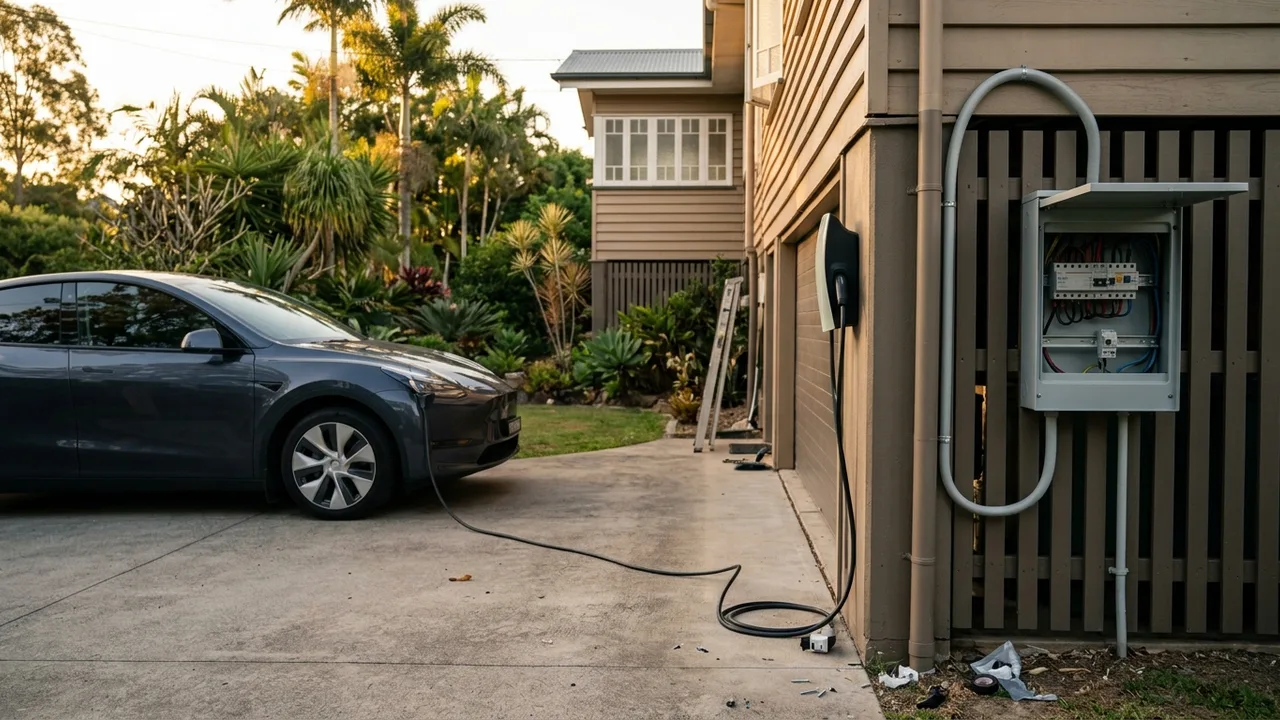
A compliance inspection isn't just a visual check. A thorough inspection covers:
- Continuity and insulation resistance testing of the circuit cable
- RCD trip-time testing to confirm the RCD operates within the required time
- Earth fault loop impedance testing to verify the earthing path is solid
- Visual inspection of the switchboard, cable run, terminations, and the charger unit itself
- Checking the charger's labelling and installation against the manufacturer's requirements
The electrician should also check that the switchboard has enough capacity. In older homes, particularly those in Albany Creek and Ferny Grove that were built in the 1980s or early 1990s, the switchboard may have ceramic fuses or an older 60-amp main switch. A dedicated EV circuit on top of existing loads can push these beyond their designed capacity, especially in summer when air conditioning is also running hard.
If everything checks out, the electrician can issue a compliance certificate for the existing installation. If faults are found, they'll quote to rectify them before certifying.
DIY Visual Checks You Can Do First
Before calling anyone out, there are a few things you can look at yourself. These won't replace a professional inspection, but they can tell you whether something is obviously wrong.
- Look at the cable between the switchboard and the charger. Is it clipped neatly to the wall or ceiling, or is it dangling loose?
- Check the charger's label. It should show the manufacturer name, voltage rating, and an Australian compliance mark (RCM, the tick-and-C symbol).
- Open the switchboard cover (do not touch anything inside, just look). Is there a dedicated breaker labelled for the EV charger? Is it a combined RCD/circuit breaker (RCBO), or just a plain breaker?
- Look at the area around the charger mounting. Are there signs of heat discolouration on the wall, the cable, or the unit itself? Any burning smell?
If anything looks obviously wrong, stop using the charger until it's been inspected.
What It Costs to Get It Checked, and Whether It's Worth It
An EV charger inspection and compliance check typically costs less than a full installation. For most single-phase residential installs in the Carseldine area, expect to pay somewhere in the range of a couple of hundred dollars for a straightforward inspection, rising if remedial work is needed.
Compare that to the cost of a charger that damages your car's onboard charger, a house fire caused by cable failure, or the liability of an un-certificated installation when you come to sell. Most insurers will ask about electrical compliance when assessing a fire claim. An un-certificated EV charger installation could complicate that process significantly.
The honest trade-off: if the charger is under two years old, was installed by a licensed electrician, and you have the compliance certificate, you probably don't need an inspection unless something is behaving oddly. If it's older, the documentation is missing, or you're not sure who did the work, an inspection is worth the cost.
When to Upgrade Rather Than Certify
Sometimes the right answer isn't to certify the existing installation. It's to do it properly.
If the switchboard is old, the cabling is undersized, or the charger itself is a cheap unit without proper Australian certification, the cost of remediation may approach the cost of a fresh installation. In that case, a new install gives you a clean compliance record, correct equipment, and typically a manufacturer warranty starting from scratch.
We've seen this come up in older homes in Bald Hills and Boondall where the original install was done cheaply during the early EV adoption years. The charger itself was fine, but the supporting infrastructure wasn't done to a standard we'd be comfortable certifying. In those cases, we're upfront about the options and the costs of each.
A Reasonable Next Step
If you're unsure about a charger installation at your property, the most sensible move is to have a licensed electrician inspect it. Ask specifically for an EV charger compliance check, not just a general electrical inspection. The two overlap but aren't the same.
We cover Carseldine, Bracken Ridge, Sandgate, Brighton, Boondall, Banyo, Bald Hills, Albany Creek, and Ferny Grove. If you'd like us to take a look, we're happy to discuss what we'd inspect and what we'd be looking for before you commit to anything. A straight conversation about your specific setup is a good starting point.
Quick answers