EV Charger Installation guide
What drives the cost of an EV charger installation in Brisbane?
What drives the cost of an EV charger installation in Brisbane?
The short answer: cable run length, your existing switchboard capacity, and the charger hardware itself. Those three factors explain most of the variation you'll see in quotes, which in the Brisbane area typically range from around $1,800 to $4,500 for a complete home installation. Everything else - wall type, conduit, permit fees - adds smaller amounts on top.
If you've already had a quote that surprised you in either direction, the sections below should help you understand what's inside that number.
The charger itself: hardware is only part of the story
A Level 2 wall-mounted charger (the kind that runs on a 32-amp dedicated circuit and adds roughly 20-25 km of range per hour) costs anywhere from about $500 to $1,500 for the unit alone, depending on brand and features. Smart chargers with Wi-Fi scheduling, solar integration, and app monitoring sit at the higher end. Basic single-function units sit lower.
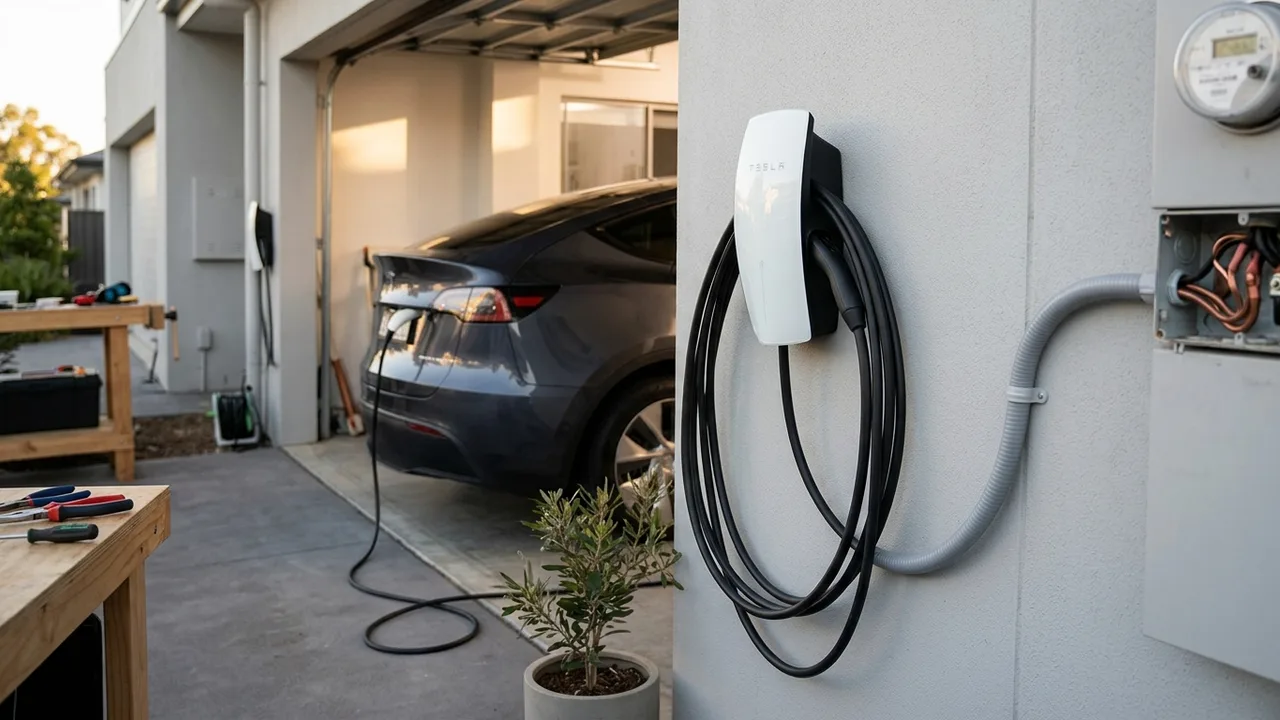
But hardware is rarely where the big cost differences come from. Two homes side by side in Carseldine or Albany Creek can get identical chargers and end up with quotes $1,500 apart, purely because of what the sparky has to do to get power from the switchboard to the charger.
A few things worth knowing when comparing charger specs:
- Load-balancing capability matters if you have solar or if you want to avoid overloading your home circuits during peak use.
- IP rating affects outdoor durability. A carport-mounted unit in a bayside suburb like Sandgate or Brighton is exposed to salt air and needs at least IP54; IP65 is better.
- Tethered vs untethered: tethered chargers have the cable permanently attached; untethered need you to bring your own. Tethered is more convenient but slightly harder to swap out later.
Cable runs: the biggest variable in most quotes
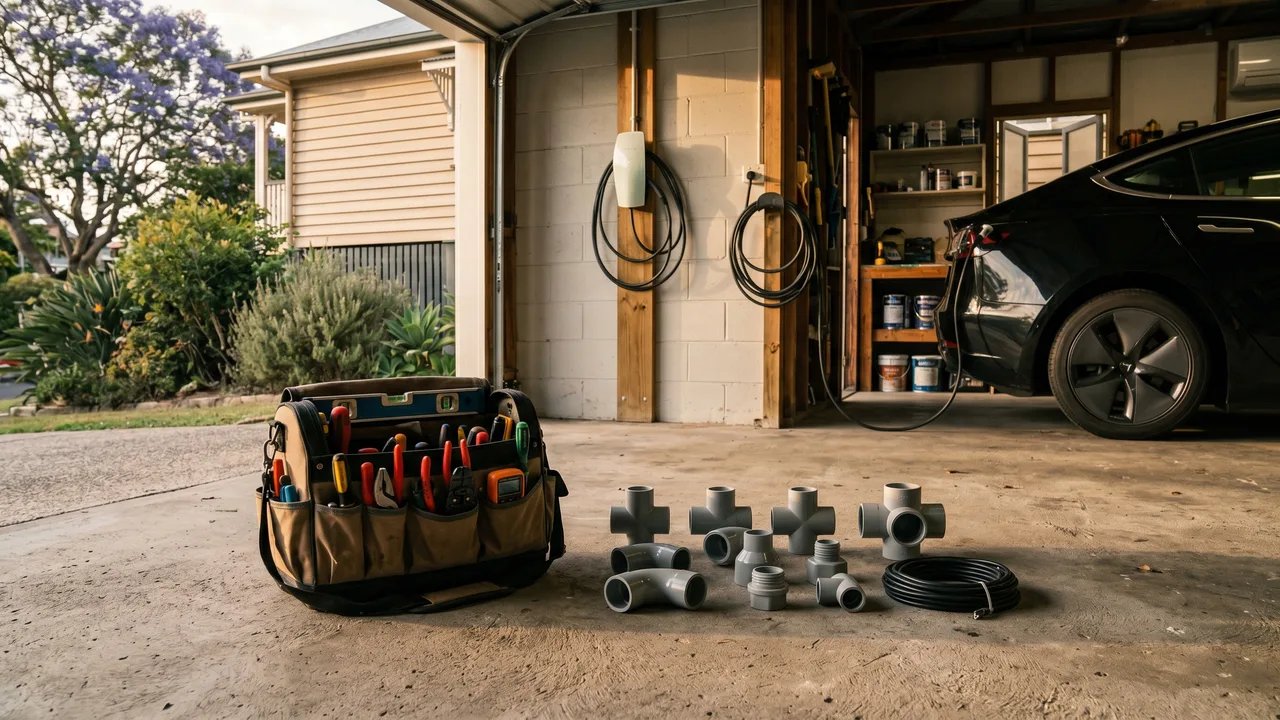
This is the one most homeowners don't anticipate. A sparky needs to run a dedicated circuit from your switchboard to where the charger mounts. If the switchboard is in the garage and the charger is two metres away, that's a straightforward job. If the switchboard is on the opposite side of a double-brick Queenslander and the car parks under the house, the cable run might be 20-30 metres through concrete or timber framing.
In Brisbane's older housing stock - and there's plenty of it in suburbs like Ferny Grove and Bald Hills - subfloor cable runs through hardwood framing add labour time. Concrete slabs (common in 1980s-2000s builds in Boondall and Banyo) sometimes mean surface conduit or more complex routing.
As a rough guide:
- A clean, short run (under 10 metres, clear path): adds minimal cost beyond the basic installation.
- A medium run (10-20 metres, some obstacles): typically adds $200-$500 in labour and materials.
- A long or complex run (over 20 metres, slab, double-brick, or roof cavity): can add $500-$1,000 or more.
Ask any sparky to walk you through the proposed cable route before you accept a quote. A good quote itemises this.
Switchboard capacity: the upgrade question
Older homes - and Brisbane has a lot of them, particularly pre-2000 builds across the northern suburbs - often have switchboards that weren't designed for a 7.4 kW dedicated EV circuit on top of air conditioning, induction cooking, and a hot water system.
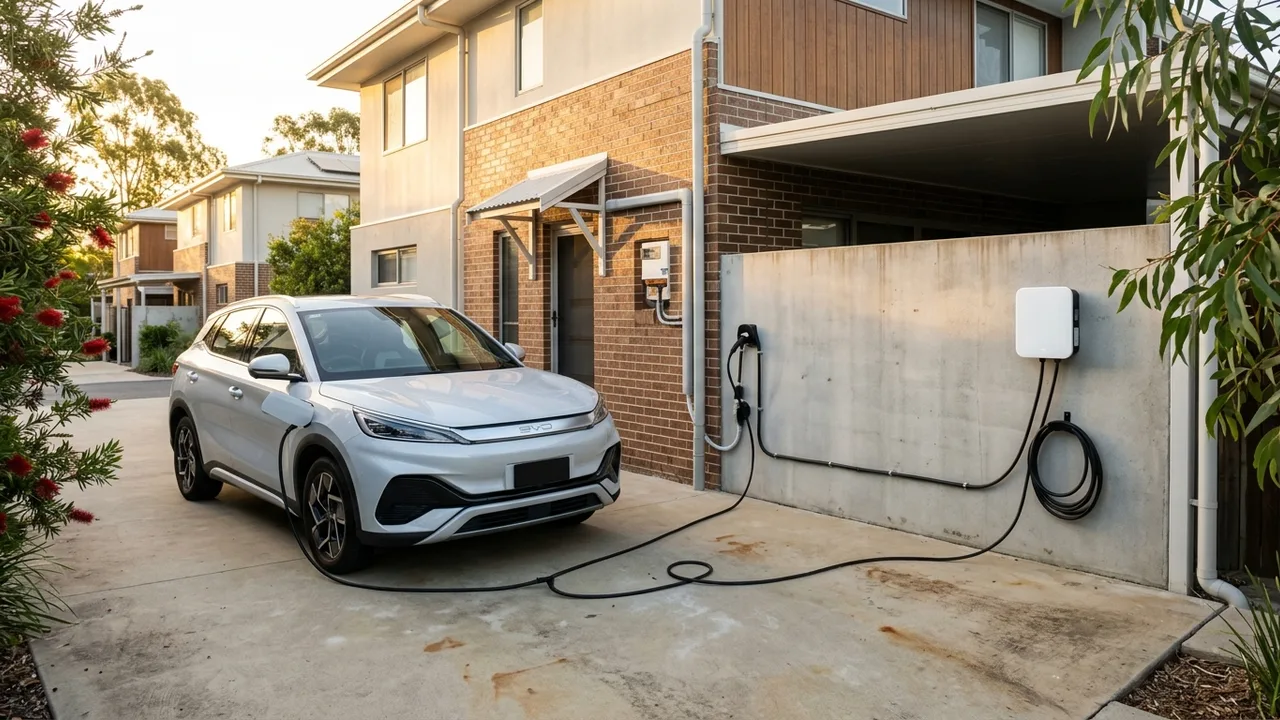
A switchboard upgrade is not always required, but when it is, it typically adds $800-$1,800 to the job. What triggers the need:
- No spare circuit breaker slots for a dedicated EV circuit.
- A 60-amp single-phase main that's already close to capacity.
- Old ceramic fuses rather than modern circuit breakers (these are a safety and compliance issue regardless of EV charging).
- No residual current device (RCD) protection, which is required on new circuits.
If your switchboard is already modern with spare capacity, you'll likely avoid this cost entirely. If you're in a 1970s or 1980s home in suburbs like Bracken Ridge or Bald Hills, budget for the possibility.
There's a real trade-off here: some installers will fit the charger without upgrading an undersized switchboard to keep the quote lower. That's not a saving - it's a liability. A compliant installation protects you with your insurer and with the network operator.
Single-phase vs three-phase: faster isn't always worth it
Most Brisbane homes run on single-phase power. A standard 7.4 kW single-phase Level 2 charger will fully charge most EVs overnight. For the majority of drivers doing 60-80 km a day, this is genuinely all they need.
Three-phase power allows chargers running at 11 kW or 22 kW, cutting charge times roughly in half or more. But three-phase installation comes at a cost:
- The charger hardware itself costs more (typically $500-$1,000 more than equivalent single-phase).
- If your home doesn't already have three-phase supply, connecting it through Energex involves an application, a fee, and lead time - often several weeks. That connection fee alone can be $1,000-$2,500 depending on distance from the network.
- Not all EVs can use three-phase charging at home anyway. Check your vehicle's onboard charger rating before going this route.
Three-phase makes strong sense if you have two EVs, a home-based business with a work vehicle, or a property that already has three-phase supply (fairly common in newer builds and some properties in light-industrial adjacent areas). For a single household EV with overnight charging time available, single-phase is the more practical spend.
Solar integration: worth doing if you're already solar-equipped
Brisbane gets enough sun that solar-optimised EV charging is genuinely practical - not just a marketing talking point. If you have rooftop solar (photovoltaic (PV) panels), pairing the charger with a solar diversion function means your car charges preferentially on excess solar generation rather than grid power.
The cost to add this varies:
- If your existing solar inverter supports load control (many modern Fronius, SolarEdge, and Sungrow units do), integration is often a software or communications cable job - add $150-$400 to the install.
- If you need a separate solar diversion controller or a smart charger with built-in solar management, add $300-$700 for the hardware.
- If your solar system is older and incompatible, you may need to weigh up whether upgrading the inverter is worth it for this purpose alone (usually not, unless you had other reasons to upgrade anyway).
For a home in Carseldine or Albany Creek with a north-facing roof and a 6.6 kW solar system, the payback on smart solar charging is measurable inside a few years at current grid rates.
What a fair quote should include
A complete, compliant EV charger installation quote should cover:
- Supply and installation of the charger unit.
- All cabling, conduit, and fixings.
- A dedicated circuit and circuit breaker.
- RCD protection on the circuit.
- Commissioning and a test run.
- Certificate of Testing and Compliance (sometimes called a Form 4) - this is a legal requirement in Queensland, not an optional extra.
It should also flag upfront whether a switchboard assessment is needed and what triggers a price variation (for example, if the cable run is longer than expected once the wall is opened).
If a quote doesn't mention the compliance certificate, ask about it explicitly. You'll need it if you ever sell the property or make an insurance claim.
A closing thought
Getting EV charging sorted at home is a one-time job that pays off every time you plug in. The cost range is real - $1,800 for a straightforward single-phase install in a modern home with a clear cable run, up to $4,500 or more for a complex setup involving switchboard upgrades, long runs, or three-phase connection.
The smartest thing you can do before accepting a quote is walk the sparky through your garage, show them the switchboard, and ask them to explain the cable route. A good installer will spend ten minutes doing that assessment before quoting, not after. We do that on every job we quote across Carseldine, Bracken Ridge, Sandgate, Albany Creek, Ferny Grove, and the surrounding suburbs - because a quote you understand is a quote you can trust.
Quick answers