EV Charger Installation guide
Can you install a home EV charger yourself, or do you need a licensed electrician?
The Short Answer
In Queensland, you cannot legally install a home EV charger yourself. Any fixed wiring work, including running a dedicated circuit to a wall-mounted charger, must be done by a licensed electrician. That applies whether you live in Carseldine, Bracken Ridge or anywhere else in the state. A DIY attempt is not just a code violation; it can void your home insurance and create a genuine fire risk.
That said, there is real value in understanding what the job involves before you book anyone. Knowing the basics helps you ask better questions, spot a fair quote, and avoid paying for work you do not need.
What "Installing a Home EV Charger" Actually Means
There is a spectrum of effort here, and where your situation falls on that spectrum affects both the cost and the complexity.
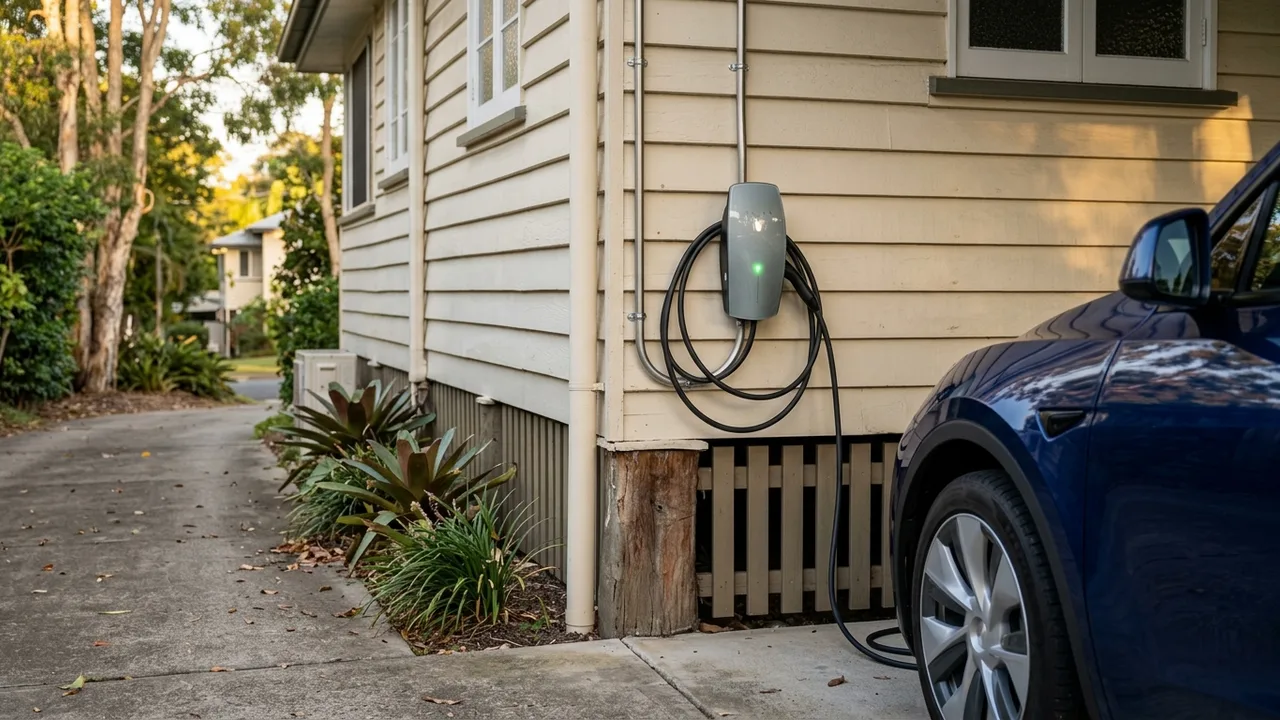
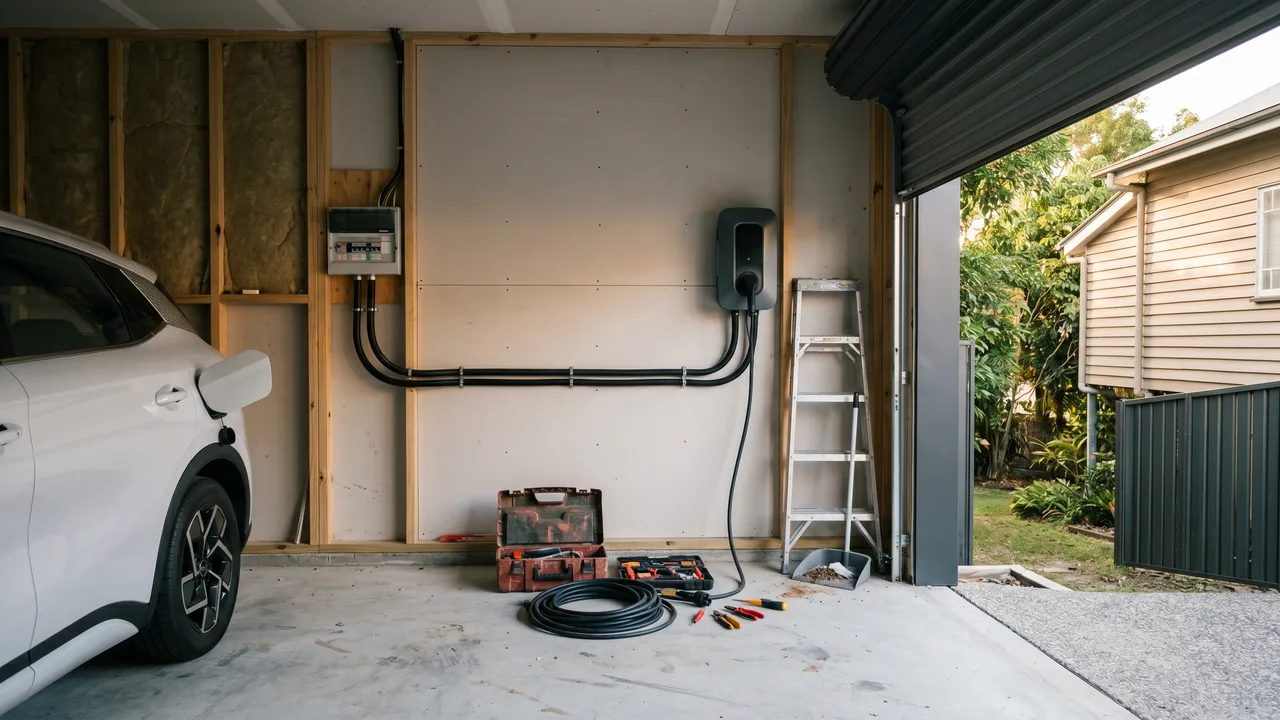
At the simpler end, your home already has a modern switchboard with a spare circuit-breaker slot, your garage is close to the meter box, and you want a Level 2 AC charger (typically 7 kW) on the wall. In that case the electrician is running a dedicated 32-amp circuit, mounting the charging unit, and connecting it up. Straightforward job. Typically a few hours on site.
At the more complex end, your switchboard is original to a 1970s Queenslander, your garage is at the back of a 600-square-metre block, you want three-phase supply for a faster charger, and your solar inverter needs to be integrated so the car charges when the sun is shining rather than pulling from the grid. That is a different scope entirely.
Most homes in the northern Brisbane suburbs we cover, places like Albany Creek, Bald Hills and Ferny Grove, tend to fall somewhere in the middle. The switchboard often needs a check, sometimes an upgrade, but the cable run is rarely extreme.
Why Queensland Law Requires a Licensed Electrician
Queensland's Electrical Safety Act 2002 is unambiguous. Electrical installation work is defined as any activity that connects, alters or adds to fixed wiring. Installing a wall-mounted EV charger involves exactly that. It is not like plugging in an appliance.
Beyond the legal obligation, there are practical reasons the rule exists:
- A dedicated EV charging circuit draws 32 amps continuously for hours at a time. That is a sustained load that ordinary household wiring is not designed to carry on a casual basis.
- A charger pulling that load through an undersized cable or a poorly rated connection can cause wiring to overheat inside walls, where you cannot see it.
- Insurance policies for home and contents typically exclude damage caused by unlicensed electrical work. If a fire starts in the wall cavity, your insurer will investigate how the circuit was installed.
A licensed electrician issues a Certificate of Test (COT) after the work, which is the document that proves the installation is compliant. You need that certificate. Without it, the work is invisible to your insurer and to any future buyer of your home.
What You Can Legitimately Do Yourself
There are parts of the process that do not involve fixed wiring, and you are free to handle those yourself.
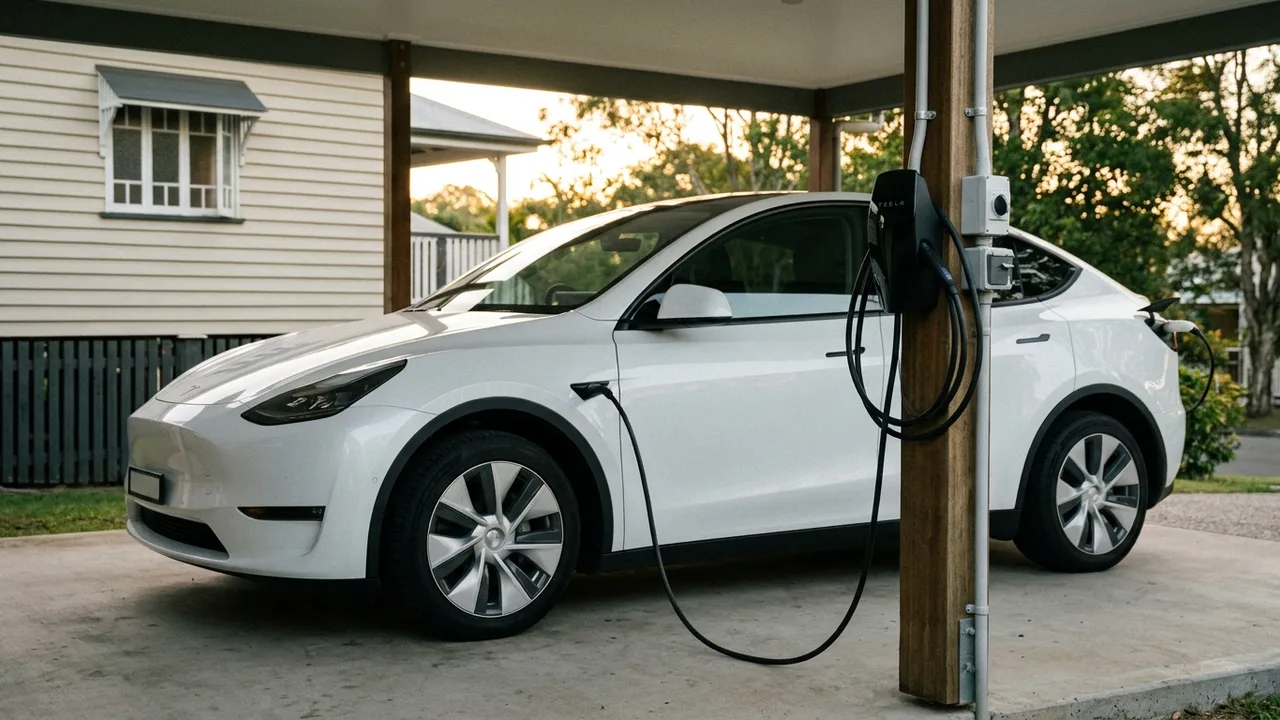
Choosing the charger. You can research and purchase the charging unit before the electrician arrives. Most licensed installers are happy to work with a customer-supplied unit, though check first, because some prefer to supply the hardware themselves as part of their service guarantee. Common brands available in Australia include Wallbox, Zappi and Fronius Wattpilot (the last one is particularly relevant if you have a Fronius solar inverter, as the integration is clean).
Deciding on the mounting location. Think about where the charging cable will reach the car's charge port. For most garage setups that is a wall to the side or rear of the parking space, roughly 900 mm to 1200 mm off the ground. Having this worked out before the sparky arrives saves time on the day.
Checking your switchboard. You can open the switchboard panel cover (not the inner enclosure) and count the spare breaker slots. If there are none, a switchboard upgrade is almost certainly part of the quote. Worth knowing in advance.
Talking to your body corporate early (for apartment or townhouse owners in places like Boondall or Banyo, where strata living is more common). Getting approval for a dedicated circuit in a basement carpark can take weeks. Start that conversation before you book an electrician.
What the Job Typically Costs in Brisbane
For a standard single-phase Level 2 charger installation in a detached home with a reasonably modern switchboard, expect to pay somewhere in the $1,800 to $2,500 range as a rough guide. That typically covers supply of the charging unit, the dedicated circuit, and the compliance certificate.
If the switchboard needs upgrading, add roughly $800 to $1,500 depending on the size and age of the existing board. Older homes in suburbs like Sandgate and Brighton that still have ceramic fuse holders rather than circuit breakers almost always need this step.
Three-phase installations cost more, generally $3,000 to $4,500 for the full job, but they halve the charging time for vehicles that support three-phase AC charging. Worth it if you drive a lot and overnight charging at 7 kW leaves the battery only partially full by morning.
Solar integration adds to the scope but can meaningfully reduce your long-term electricity costs. If you have rooftop panels and a compatible inverter, smart-charging your car on surplus solar can be genuinely cost-effective over a few years.
How to Assess a Quote
A quote that just says "EV charger install, $X" is not enough. Here is what to ask for or look for in writing:
- What charger model is included (or confirm they will install yours if you have already purchased it)
- Whether a switchboard upgrade is included or excluded, and what triggers one
- Cable run length and method (surface conduit, in-wall, or underground for detached garages)
- Whether the COT is included in the price
- Estimated time on site, which gives you a rough sense of whether the job has been properly scoped
A quote that accounts for these specifics usually reflects someone who has thought the job through. A quote that does not may change significantly once the work starts.
Our Honest Recommendation
If you are comfortable with what the job involves and you have a realistic sense of your home's electrical setup, booking a licensed electrician for a home EV charger installation is genuinely straightforward. It is not a mysterious or particularly risky procurement decision.
The main thing to avoid is booking the cheapest quote before confirming what it actually includes. A $1,400 quote that excludes a necessary switchboard upgrade is not $1,400. A $2,200 quote that includes the charger, the upgrade and the compliance documentation often represents better value.
We install EV chargers across Carseldine, Bracken Ridge, Bald Hills, Albany Creek, Ferny Grove, Banyo, Boondall, Brighton and Sandgate. If you want a clear scope and a fixed price before anyone picks up a tool, that is how we prefer to work too. Give us a call and describe your setup; it usually only takes a few minutes to give you a realistic picture of what your installation will involve.
Quick answers