EV Charger Installation guide
Can you get an EV charger installed in a Brisbane apartment or strata complex?
Yes, But It Takes More Work Than a House Install
The short answer is yes, you can get an EV charger installed in a Brisbane apartment or strata complex. The longer answer is that it involves more people, more steps, and occasionally more patience than a standard house installation. Understanding why makes the whole process a lot less frustrating.
Whether you live in a high-rise near the CBD, a mid-density complex in the Inner West, or a townhouse cluster in the northern suburbs, the core challenge is the same: you do not own the common areas, and someone else's approval matters.
Why Strata Adds Layers That a House Install Doesn't
When you install a charger at a standalone house in Carseldine or Bracken Ridge, you make the call, hire an electrician, and get it done. A strata situation is different because the carpark, basement, or shared driveway typically falls under the common property managed by the body corporate (also called the owners corporation in some states, though Queensland uses "body corporate" under the Body Corporate and Community Management Act 1997).
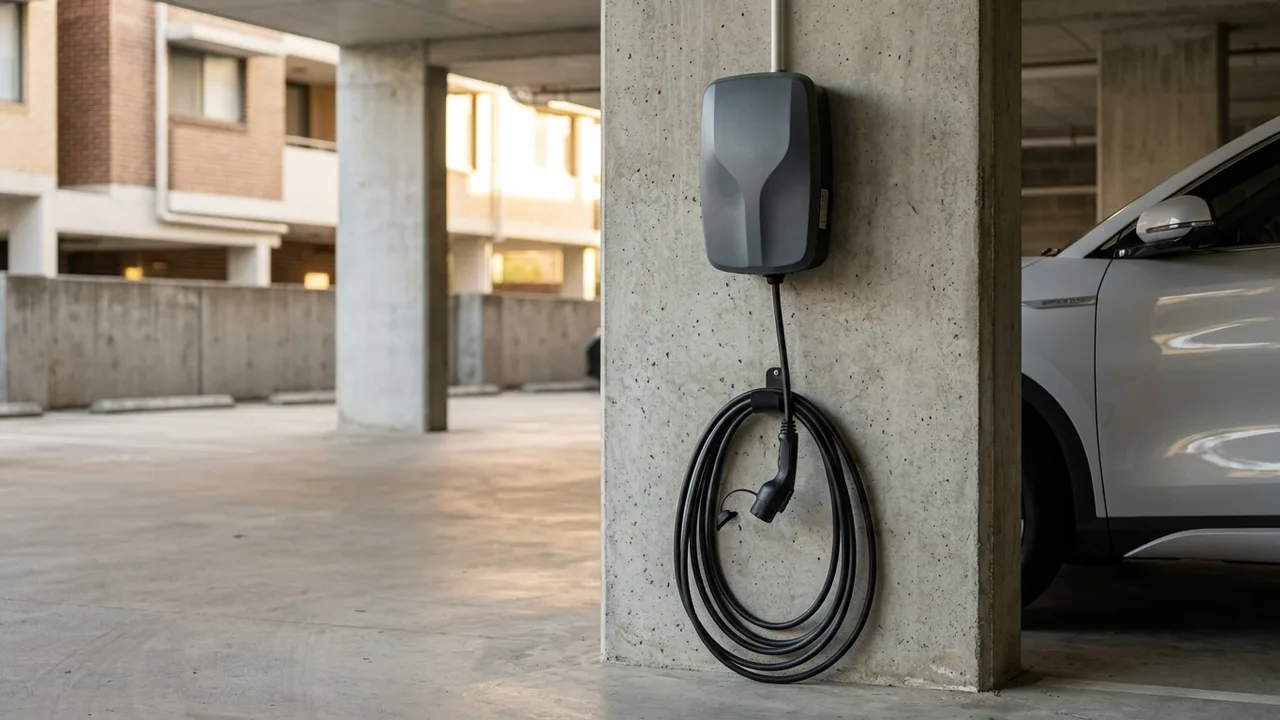
That means:
- You need body corporate approval before any electrical work begins.
- The carpark switchboard or meter room may be common property, which complicates how a new circuit gets run.
- Other owners in the building have a say, even if they drive petrol cars and couldn't care less about EV charging.
None of this makes installation impossible. It just means the approval process happens before the electrical work, not after.
Getting Body Corporate Approval: What to Expect
Queensland body corporate rules do allow owners to make improvements to their lot, but running a new electrical circuit into a carpark space usually touches common property, so it typically requires a formal committee or general meeting vote.
Here is a rough picture of how that usually goes:
- Submit a written request to the body corporate committee, outlining what you want to install, where the circuit will run, and who will do the work.
- The committee either approves it under their own authority (for minor works) or refers it to a general meeting of all owners.
- Approval is often granted with conditions, for example that you pay for the installation yourself, that the charger is on its own sub-meter so your electricity usage is separate from building power, and that the work is done by a licensed electrician.
- Once approved, a licensed electrician can proceed.
The sub-metering requirement is worth noting. Buildings are understandably cautious about one resident's EV charging showing up on the common area electricity bill. A dedicated circuit from your apartment's own meter, or a separately metered circuit in the carpark, solves that cleanly. We can set this up as part of the installation.
Timing varies. A responsive committee might turn this around in a few weeks. A slow or divided one could stretch it to several months. If you're buying into a complex specifically because you drive an EV, it is worth checking the building's track record on approving owner improvements before you sign.
The Electrical Reality: Where the Circuit Comes From
Even after you have approval, there is a practical question: how does the power get to your carpark space?
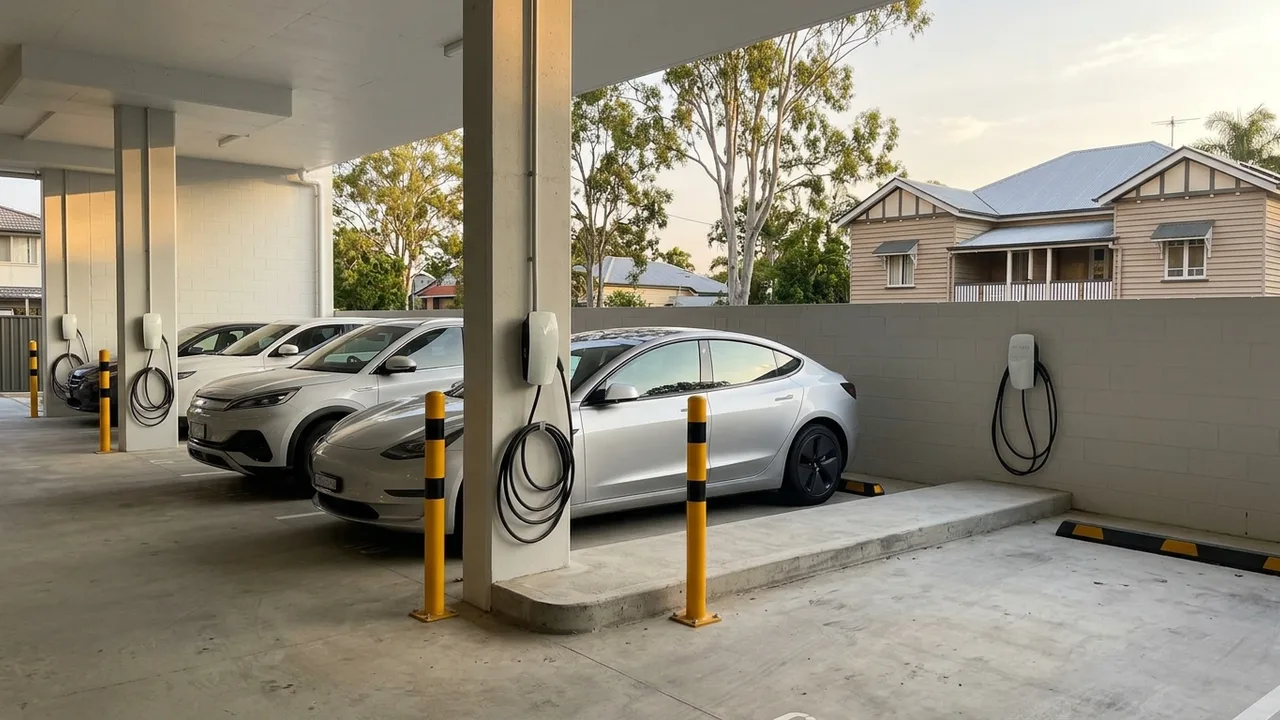
In a townhouse with its own garage, this is often straightforward. The garage may already have a power circuit, and a dedicated charger circuit can be added from your own switchboard. Townhouse strata in suburbs like Albany Creek or Ferny Grove often fall into this category, and the install can look quite similar to a freestanding house job.
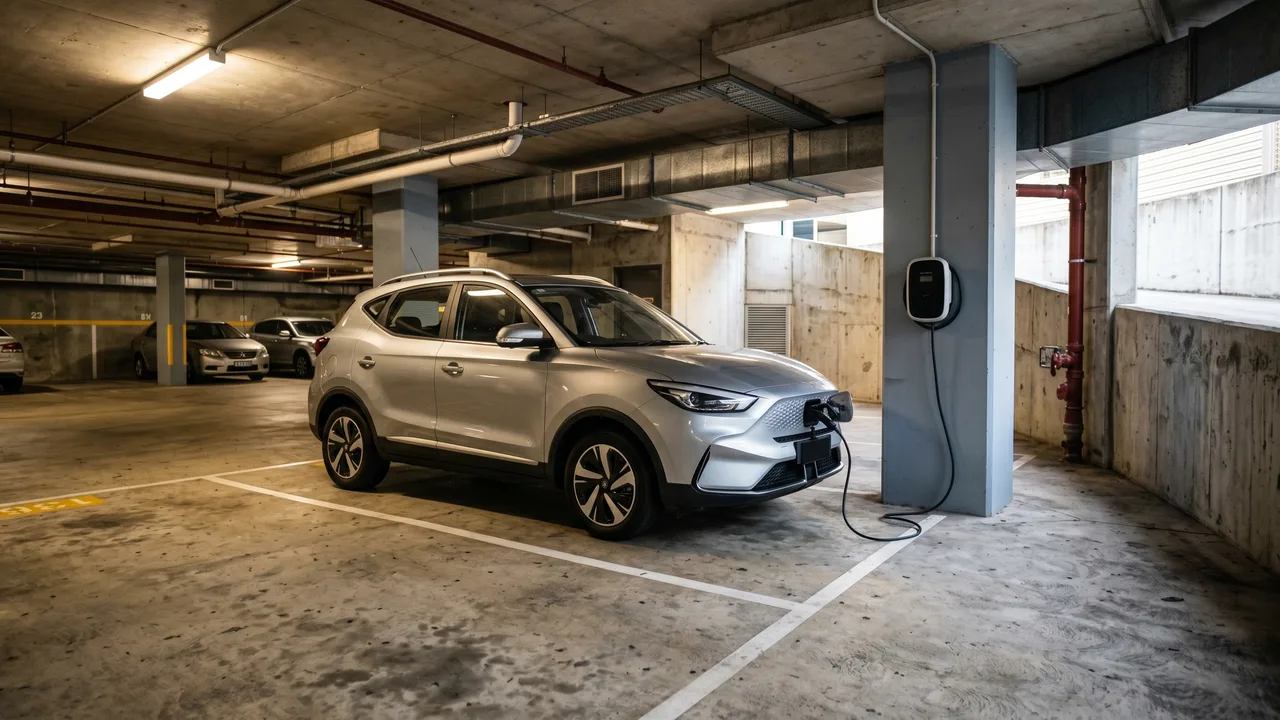
In a basement or podium carpark, it is more complex. Options typically include:
- Running a new circuit from your apartment's own distribution board down to your car space. This works if the cable route is manageable and does not require cutting through excessive common-area walls or ceilings.
- Installing a sub-metered circuit tapped off the building's common supply in the carpark, with the cost of electricity recovered through the sub-meter.
- In buildings where multiple residents want charging, a more systematic approach with a dedicated EV charging distribution board in the carpark can be more cost-effective per resident than individual runs.
The right solution depends on the building's layout, the age of its switchboard infrastructure, and how many people want charging now versus in the next few years. Older apartment blocks built in the 1970s and 1980s sometimes have switchboards and cable routes that were not designed with any of this in mind. Newer buildings, particularly those built after around 2015, are more likely to have conduit or space provisions that make installation easier.
What Does It Actually Cost in a Strata Setting?
For a townhouse carport where your own switchboard is nearby, you are often looking at a similar cost to a house install, roughly $1,800 to $2,500 for supply and installation of a quality Level 2 charger. If the switchboard needs upgrading to handle the new circuit safely, add $800 to $1,500 on top of that.
For a basement carpark with a long cable run or sub-metering requirements, costs rise. A realistic range for that kind of job is $2,500 to $4,500, sometimes more if the building's infrastructure needs significant remediation. We quote each job individually because the variables really do matter here. A flat rate for strata work is not something we offer, because it would either be misleading or heavily padded to cover unknowns.
It is also worth knowing that the charger hardware itself, typically a wall-mounted Level 2 unit with a 7kW or 11kW output, represents a chunk of that cost regardless of the site. The installation labour and materials make up the rest.
Solar Integration in Apartments: The Honest Picture
If you own a house in Bald Hills or Sandgate with solar panels, integrating your EV charger with your solar system is straightforward and genuinely worthwhile. You charge during the day when the sun is generating, and your fuel cost drops significantly.
In most apartments, the picture is more complicated. Rooftop solar in a strata building is common property, and the body corporate controls it. Unless the building has a shared solar arrangement that distributes credits to individual apartments (some newer complexes do), you are unlikely to be charging from your own solar. Building-wide virtual net metering arrangements exist but are not yet common in Brisbane's older medium-density stock.
For apartment residents, the more realistic win is time-of-use tariff management. Charging overnight on an off-peak tariff, if your energy plan offers one, can still reduce your cost per kilometre considerably compared to public DC fast-charging.
What to Do Next if You're in a Strata Property
Before you call anyone, get the body corporate paperwork moving. Write a clear proposal to your committee outlining the work, and ask them what conditions they typically attach to electrical improvement approvals. The earlier you start that conversation, the better.
When you do engage an electrician, ask specifically whether they have done strata installs before. It is a different scope of work to a house job, and an electrician who has dealt with carpark sub-metering, long cable runs, and documentation requirements for body corporate approval will save you grief.
We work across Brisbane's northern suburbs, including strata jobs in Boondall, Banyo, and the surrounding area. If you are in the early stages of figuring out whether your building can accommodate a charger, a site visit and a written scope of work can give you something concrete to take to your body corporate committee. That kind of documented proposal often moves approvals along faster than a verbal description.
It is a genuinely solvable problem in most cases. It just takes a bit more groundwork than plugging something into a garage wall.
Quick answers